World Arabic Language Day: Why 18 December, Themes and Type Ideas
World Arabic Language Day is the United Nations observance held every 18 December to celebrate Arabic, one of the six official languages of the UN. In Arabic it is اليوم العالمي للغة العربية (al-Yawm al-ʿĀlamī lil-Lugha al-ʿArabiyya). This guide gives the exact decisions behind the date, the UNESCO themes we could check at the source, and practical ways to mark the day through the script itself, with free fonts you can download and print.
Why 18 December
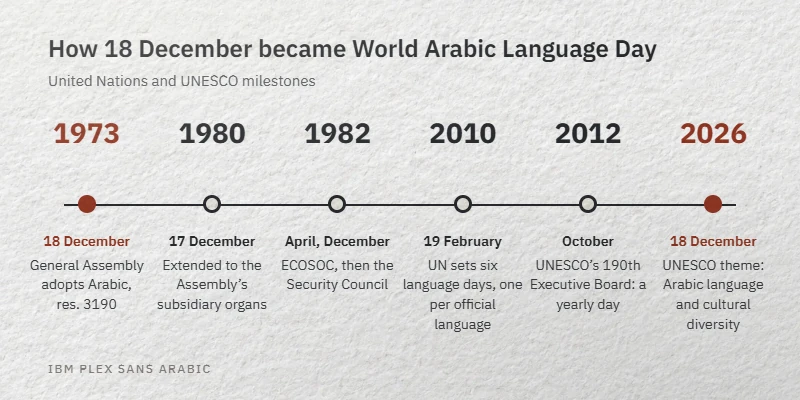
On 18 December 1973, at its 28th session, the UN General Assembly adopted resolution 3190 (XXVIII). It included Arabic “among the official and the working languages of the General Assembly and its Main Committees” and amended the Assembly’s rules of procedure to match.
The detail matters, because the usual shorthand (“Arabic became the UN’s sixth official language in 1973”) skips the steps that followed. The UN library’s official languages timeline lists them:
| Date | Body | Decision |
|---|---|---|
| 18 December 1973 | General Assembly and its Main Committees | Resolution 3190 (XXVIII) |
| 17 December 1980 | Subsidiary organs of the General Assembly | Resolution 35/219 A |
| 15 April 1982 | Economic and Social Council (ECOSOC) | Council decision |
| 21 December 1982 | Security Council | Resolution 528 (1982) |
Arabic was not new to the UN system in 1973. The explanatory note submitted to UNESCO’s Executive Board in 2012 points out that Arabic was already an official language at UNESCO, the FAO, the WHO and the ILO before the Assembly vote. The 1973 date is the symbolic one: the day the main deliberative body of the UN started working in Arabic.
From a UN language day to a UNESCO day
The day exists because of a wider UN program on multilingualism. On 19 February 2010, just before International Mother Language Day, the UN Department of Public Information announced a day for each of the six official languages. The UN’s official languages page lists them today:
| Language | Day | Why that date |
|---|---|---|
| French | 20 March | International Day of La Francophonie |
| Chinese | 20 April | Tribute to Cangjie, credited with creating Chinese characters |
| English | 23 April | Shakespeare’s traditional birthday |
| Spanish | 23 April | Shares the date with English; first set on 12 October in 2010 |
| Russian | 6 June | Birthday of the poet Alexander Pushkin |
| Arabic | 18 December | Resolution 3190 of 1973 |
Arabic is the only one of the six whose day commemorates a UN decision rather than a writer, a legend or a cultural date.
UNESCO came second. In October 2012, at the request of Morocco and Saudi Arabia, the item “World Arabic Language Day” went on the agenda of the 190th session of UNESCO’s Executive Board (document 190 EX/48). The proposed decision invited the Director-General to include 18 December “as one of the international days marked by UNESCO”. UNESCO states that it has celebrated the day every year since 2012, and its headquarters in Paris hosts the main event.
World Arabic Language Day themes since 2023
Each edition has a theme, set by UNESCO and its partners. We list only the themes we read on UNESCO’s pages or its official event listings; wordings vary between languages, so these are the English titles as published.
| Year | Theme | Note |
|---|---|---|
| 2026 | Arabic language and cultural diversity: Celebrating dialogue and mutual understanding | Friday 18 December, UNESCO Headquarters, Room II, sessions in Arabic, English and French |
| 2025 | Innovative Pathways for Arabic: Policies and Practices for a More Inclusive Linguistic Future | Education, media, technology and public policy |
| 2024 | Arabic Language and AI – Advancing Innovation While Preserving Cultural Heritage | UNESCO’s event page puts Arabic at about 3% of online content |
| 2023 | Arabic – The Language of Poetry and the Arts | Fiftieth anniversary of resolution 3190 |
According to UNESCO’s announcement (checked on 23 October 2026), the 2026 celebration is organized with the Permanent Delegation of Saudi Arabia to UNESCO and supported by the Sultan Bin Abdulaziz Al Saud Foundation, as in 2024 and 2025. Registration and the program are on UNESCO’s World Arabic Language Day page; check it in December, when the agenda is final.
A theme is an invitation, not a rule. A school can work on “dialogue and mutual understanding” with a bilingual poster; a design studio can answer it with a type specimen in two scripts.
Celebrate the script, not just the language
Most lists of ideas for the day stop at poetry readings and quizzes. Those work, but Arabic offers something few languages do: more than thirteen centuries of written styles, from angular Kufi lettering to the quick, compact Ruq’ah of everyday handwriting. Our guide to Arabic calligraphy styles sets the main ones side by side. Letting people see and handle those forms is the most memorable way we know to mark 18 December.
One phrase, five voices
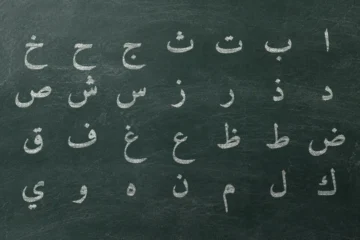
Pick a short phrase and set it in five free fonts, one per sheet, at the same size. We use لغة الضاد (lughat al-ḍād, “the language of the ḍād”), the classic nickname of Arabic. It is a good test phrase: it shows the letter ض (ḍād), a غ (ghayn) in the middle of a word, the closed ة (tāʾ marbūṭa) at the end, and two letters that never join to the left, alif and dal, which split الضاد into three pieces. If the group is new to the script, start with the Arabic alphabet and its joining rules. Hang the sheets side by side and ask visitors which one feels oldest, most modern, most handwritten. The differences between a Kufi, a Naskh and a Ruq’ah become obvious in a minute.
A poster workshop in one afternoon
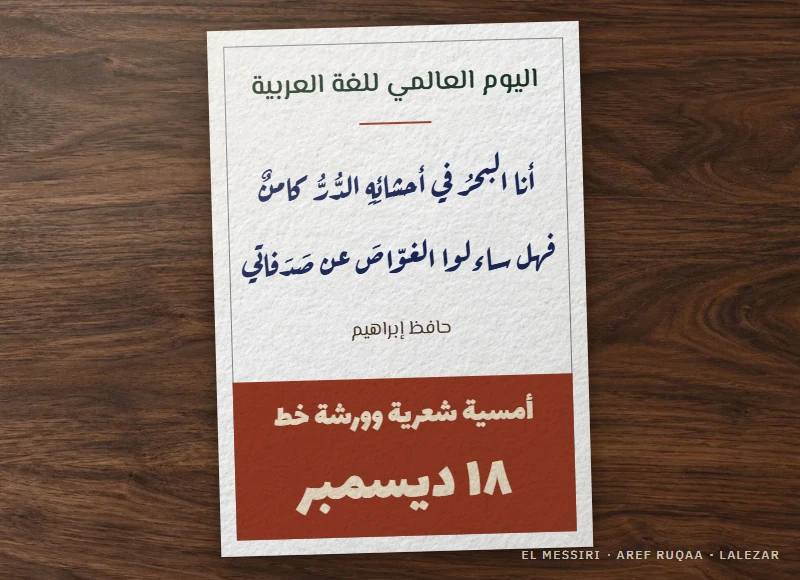
Give each group a short text with real meaning (a line of poetry, a proverb, the theme of the year) and three fonts with distinct jobs: one for the title, one for the quotation, one for the date and place. Plan about ninety minutes to sketch, compose and print an A3 poster. The example below pairs a verse by the Egyptian poet Hafez Ibrahim (1872–1932), spoken by the Arabic language itself, with three free families:
أنا البحرُ في أحشائِهِ الدُّرُّ كامنٌ … فهل ساءلوا الغوّاصَ عن صَدَفاتي
“I am the sea, with pearls hidden in its depths: did they ever ask the diver about my shells?”
On the poster, each font has one job.
First words for learners
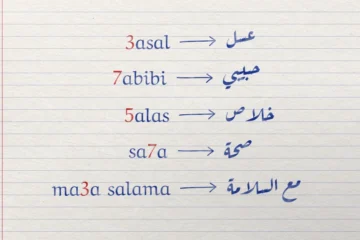
Learners who cannot type Arabic yet can still make their own card. On our online Arabic keyboard, typing 3arabi in Latin letters gives عربي (“Arabic”), and mar7aba gives مرحبا (“hello”). The direct mode adds harakat (حركات, short-vowel marks) by clicking, and the preview lets you choose a font before copying the text into a layout. For longer words, check the suggestions and ask a fluent reader before printing.
Free fonts for 18 December visuals
All the families below are in our catalog under the SIL Open Font License 1.1: free for school, commercial and print use, as long as the font itself is not sold. Weights are those of the files we distribute.
| Font | Voice | Weights | Use it for |
|---|---|---|---|
| Reem Kufi | Kufi based on early Qur’anic models and the Fatimid grid | 400 to 700 (variable) | Event names, inscriptions, the featured image of this article |
| Qahiri | Manuscript Kufi, more archaic | 400 | Decorative headings at large sizes only |
| Aref Ruqaa | Classical Ruq’ah, handwritten feel | 400, 700 | Quotations, verses, greeting cards |
| El Messiri | Naskh-based, drawn like brush lettering | 400 to 700 (variable) | Headers, invitations and program titles without vowel marks |
| Lalezar | Heavy poster lettering, after 1960s–70s Iranian film posters | 400 | Dates, slogans, one loud line per poster |
| Amiri | Book Naskh, a revival of the Bulaq Press type | 400, 700 | Program text, handouts, fully voweled poetry |
A display face carries a few words, not a paragraph. Give the running text to a reading face and keep the loud fonts for one line each. El Messiri needs one more check: on a final lam, a shadda that carries a vowel, as in كُلُّ (kullu), floats beside the letter, so set vocalized lines in Amiri. Our selection of the best free Arabic fonts sorts more families by job, and the catalog of Arabic display fonts has the full poster range. On a school computer, follow our guide to installing Arabic fonts before the workshop, not during it.
Before you print: a checklist for Arabic posters
- One digit system per poster. ١٨ ديسمبر with Eastern Arabic digits and 18 ديسمبر with Western digits are both correct. The Maghreb uses the second; much of the Mashriq and the Gulf uses the first. Mixing them on one sheet looks careless. The month name varies too: ديسمبر in Egypt and the Gulf, كانون الأول in the Levant and Iraq, دجنبر in Morocco. Use the one your readers use.
- No letter-spacing on Arabic. Tracking pulls joined letters apart. To widen a word, use the kashida (كشيدة), the tatweel stroke ـ, sparingly and only between letters that join.
- Harakat where they help. Vocalize fully for a teaching sheet; elsewhere, mark only the words a reader could misread, as on the poster above. Stay consistent across the poster, and check at print size that the marks do not collide with the line above.
- Check every join after export. If the PDF shows isolated letters running left to right, the app did not shape the Arabic. Fix it before printing a hundred copies.
- Credit the text. Name the poet or the source on the poster. The OFL asks nothing of a printed poster; keep the
LICENSE.txtwith the font if you pass the files on.
FAQ
Is 18 December a public holiday?
No. It is a UN observance. It does not by itself close schools or offices; how it is marked is up to each institution.
Is it the same as International Mother Language Day?
No. International Mother Language Day is 21 February. UNESCO’s General Conference proclaimed it on 17 November 1999 for all languages. World Arabic Language Day belongs to the series of six UN official-language days.
Why is Arabic called the language of the ḍād?
Because the emphatic letter ض (ḍād) was long described by Arabic grammarians and poets as characteristic of Arabic speech. Linguists today note that similar sounds exist elsewhere, so the nickname is a tradition, not a phonetic rule. It remains the most common way to name the language in a single phrase, which is why it is carved into this article’s featured image.