
Kufic Font: Manuscript Voices and Modern Kufi Geometry
15 fonts
Kufic script is the angular style named after Kufa, used in early Qurans and on monuments. A kufic font here takes one of two routes: historical manuscript and Fatimid models for titles, or simplified Kufi structures for signage and interfaces.
Style
Use
Access
License
Kufic script, named after Kufa
Kufi (كوفي, kufi) takes its name from Kufa, in Iraq. It is one of the first codified Arabic styles. It was used for early Quran manuscripts, mostly on parchment, between the 8th and 10th centuries, and for monumental inscriptions.
Kufi also grew decorative families. Foliated Kufi (المورق, al-muwarraq) sprouts leaves from its letters. Floriated Kufi (المزهر, al-muzahhar) adds flowers. Braided Kufi (المضفر, al-mudaffar) weaves strokes together. Square Kufi (المربع, al-murabba') is built on a grid and used in architecture. The Kufi of the Fatimid inscriptions in Cairo is another reference that type designers still draw on.
What makes a letter look Kufi
- Angles: mostly straight strokes meeting at corners, with few, tight curves.
- Long horizontals: baseline strokes stretch out, so words spread along the line.
- Geometry: square Kufi follows a strict grid; modern Arabic sans faces often borrow Kufi geometry more loosely.
- Ornament as a variant: leaves, flowers and braids belong to the decorative families; a plain Kufi does without them.
Kufi in titles, logos and screens
Historical Kufi suits cultural titles, exhibition names, book covers and identities with a heritage note. Simplified Kufi structures reach further, into signage, headers and interfaces. Several fonts below are also filed under modern Arabic sans fonts for that reason. For brand work, compare the Arabic fonts for logos.
Choosing a kufic font: historical or systematic
For a historical voice. Reem Kufi follows early Quran manuscript models and the Fatimid grid; reach for it when a title or identity should feel rooted in that heritage. The download holds the standard family, weights 400 to 700, without the Fun and Ink variants.
Qahiri is Khaled Hosny's reading of old manuscript Kufi, as regularized by the calligrapher Mohammad Abdul Qadir and named for Cairo. With one weight, it relies on size and spacing for hierarchy.
Fustat turns manuscript Kufi references into a working family: a variable file from 200 to 800, a matching Latin, and tabular digits and fractions for price lists and reports.
For a systematic, modern Kufi. Noto Kufi Arabic is the regular, even-weighted option for headings and two-script graphic systems, with Persian and Urdu support across weights 100 to 900.
Cairo builds its Arabic on a Kufi base and extends the Latin of Titillium Web. Pick it when a bilingual brand needs one variable file with a wide weight range and an optional slant.
Kufam was conceived for signage and wayfinding, with Arabic inspired by 7th-century Kufi inscriptions. It ships upright and italic variable files from 400 to 900.
Firjar is built like a compass drawing, from straight lines and quarter circles. Its width axis runs from 75 to 125 and defaults to the condensed end, so compare several widths before you adjust spacing.
Droid Arabic Kufi is an archived screen family linked to Android and ChromeOS, in two weights and without Latin. Keep it for maintaining an older interface.
For an experimental title. Blaka crosses angular Kufi with Latin blackletter for posters and artist names; you will also find it among the Arabic display fonts.
Kufi questions
Is there a free square Kufi font?
Not that we know of. The square Kufi fonts we found are commercial or limited to non-commercial use. Because square Kufi sits on a grid, a short word can be constructed by hand in a vector editor; have an Arabic reader check the result.
Can I use these Kufi fonts in a commercial logo?
Yes. The free fonts on this page are under the SIL Open Font License 1.1, except Droid Arabic Kufi, under Apache License 2.0. Both allow commercial use. Keep the license file with the font, and do not sell an OFL font on its own. Before a logo ships, the guide on how to choose an Arabic font walks through the license check.
Kufi or Naskh for body text?
For long reading, Naskh. A Kufi-based sans can carry interface text, but a historical Kufi belongs in the title, above paragraphs set in one of the Naskh fonts.
Type a brand or event name with the online Arabic keyboard. The live preview on every font page accepts pasted text, so you can compare the letter shapes one Kufi at a time.
Articles about Kufi
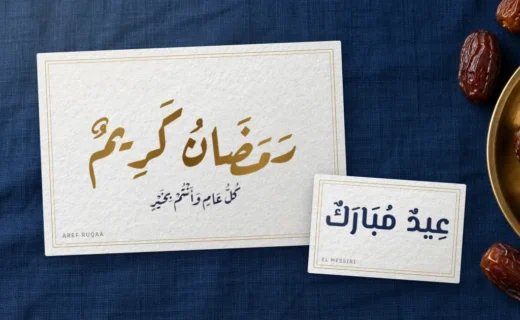
Ramadan Kareem in Arabic and Eid Mubarak: Spelling, Meaning, Lettering
Every Ramadan and Eid greeting with its exact Arabic spelling, vowel marks, meaning and reply, the Kareem or Mubarak debate, and free fonts tested… Read more : Ramadan Kareem in Arabic and Eid Mubarak: Spelling, Meaning, Lettering
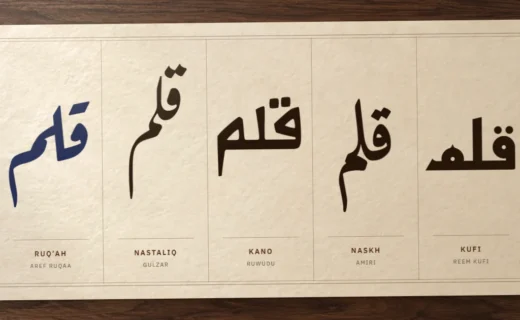
Arabic Calligraphy Styles Compared: A Visual Key to Nine Scripts
Kufi, Naskh, Thuluth, Diwani, Ruq'ah, Nastaliq, Maghribi and the rarer pens: how to tell them apart by angle, alif and baseline, where each one… Read more : Arabic Calligraphy Styles Compared: A Visual Key to Nine Scripts
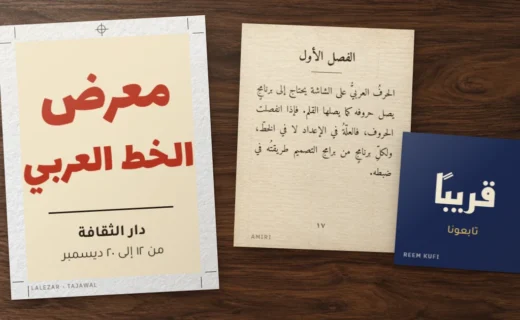
Arabic Text in Photoshop, Illustrator and InDesign: Setup Guide
Photoshop now shapes Arabic on its own; Illustrator and InDesign still need the right composer. Exact menu paths for direction, digits, diacritics and kashida,… Read more : Arabic Text in Photoshop, Illustrator and InDesign: Setup Guide
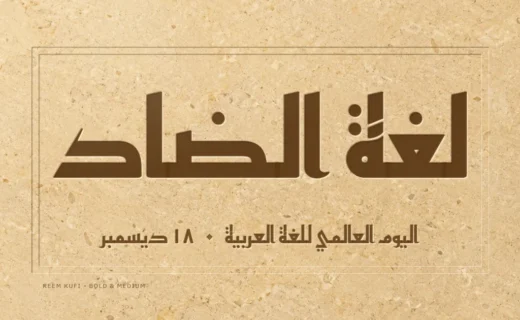
World Arabic Language Day: Why 18 December, Themes and Type Ideas
Why the UN chose 18 December, how UNESCO came to mark it, every recent theme checked at the source, and ways to celebrate through… Read more : World Arabic Language Day: Why 18 December, Themes and Type Ideas
The Best Free Arabic Fonts in 2026: 12 Picks From 109 Tested
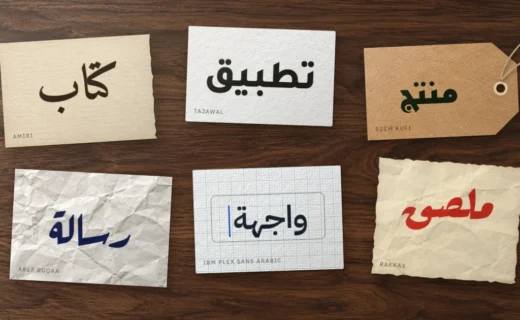
Twelve free Arabic fonts picked from 109 tested families: Amiri, Scheherazade New, IBM Plex Sans Arabic, Tajawal, Reem Kufi, Lalezar, Aref Ruqaa and more,… Read more : The Best Free Arabic Fonts in 2026: 12 Picks From 109 Tested
How to Choose an Arabic Font: A Five-Step Method
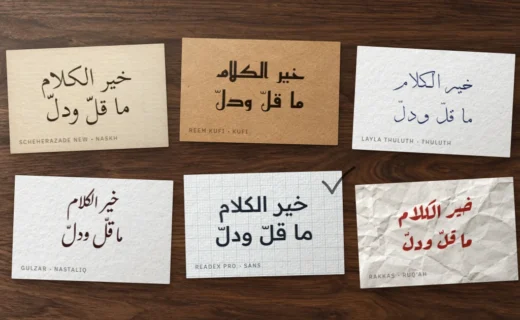
Define the job, pick one of ten Arabic styles, list your constraints, test harakat and joining with your own words, then check the license.… Read more : How to Choose an Arabic Font: A Five-Step Method