Arabic Display Font: Poster, Pop and Experimental Title Faces
37 fonts · Page 1 of 2
Arabic display fonts are drawn for large sizes: posters, covers, packaging and social posts. The free families here run from heavy poster faces and film-poster lettering to playful, brush-like and experimental designs. Pair each one with a quieter text face.
Style
Use
Access
License
Lettering made for large sizes
A display face's details are meant to be seen large. Set small or in a paragraph, they crowd together.
Many Arabic display designs carry a piece of graphic history. Some draw on the lettering of film posters from Iran and Egypt; another reinterprets an Iranian stencil design; others mix scripts or come from a design workshop. Knowing the reference helps you match the font to the message.
Kinds of Arabic display face
- Heavy poster faces: dense, dark letters that announce a title from a distance.
- Playful and pop: rounded or strongly contrasted forms for youth brands, music and food.
- Calligraphic display: a pen or brush reference, such as Ruq'ah or Naskh, enlarged for titles.
- Outline and color: hollow letters or fonts with a built-in palette (COLR). In the families listed here, these exist only as separate variants.
- Experimental: letters built from modules, crossed with Latin blackletter or drawn collectively.
Posters, packaging and social posts
Use a display face for the one line people must see first: the event name, the product, the hook of a post. Keep dates, prices and small print in a calmer family. For campaign material, see the Arabic fonts for flyers and posters; for thumbnails and title cards, the Arabic fonts for video.
Which Arabic display font for which headline
Lalezar, by Borna Izadpanah, revisits the lettering of 1960s and 1970s Film-Farsi cinema posters from Iran. Its single Regular style suits a magazine name or a loud feature title.
Jomhuria starts from Shablon, an Iranian stencil design. Kourosh Beigpour drew the Arabic and Eben Sorkin the Latin. Its nominal weight 400 is already very dark, so give it short words.
Oi, by Kostas Bartsokas, pushes slab-serif lettering to an extreme mass, despite its nominal 400 weight. Keep it to one line with ample space around it.
Badeen Display, by Hani Alasadi, plays thick strokes against thin ones and rounded shapes against sharp edges. It was conceived with Arab pop culture and youth brands in mind.
Rakkas revives Egyptian film-poster Ruq'ah of the 1950s and 1960s, with contextual alternates that change word shapes. It is also listed with the Ruq'ah fonts.
Blaka mixes Latin blackletter with sharp, angular Kufi for an experimental title. The download holds the standard monochrome family only.
El Messiri starts from Naskh but treats the stroke as brush lettering, with wide counters and Philosopher-based Latin, from 400 to 700. Use it to open an editorial spread or announce a cultural event.
Lemonada blends rounded Naskh with Diwani influences, from 300 to 700, for welcoming titles and invitations.
Handjet builds letters from repeated elements, with extra axes for the element grid and shape. macOS may show rendering artifacts, according to its official description, so test the final export.
Display font questions
Where are the color Arabic fonts?
Some families have color or outline variants, such as Blaka Ink, Blaka Hollow, Reem Kufi Ink and Cairo Play. They are separate fonts, and the catalog downloads do not include them. If the brief calls for built-in color, name the variant explicitly; the standard files have no color mode.
Is copy-paste "decorated" Arabic text a font?
No. Some sites "decorate" text, a practice Arabic users call zakhrafa (زخرفة, zakhrafa), by swapping letters for look-alike Unicode symbols, often for gaming names and profiles. That text is not a font, and screen readers and search engines may not be able to read it. For a designed title, use a real display font.
Can I set a whole flyer in one display font?
Only the title. Many display faces here have a single weight, with no bold or light to build a hierarchy, and dense letters can close up their counters and dots at small sizes. Pair the title with a sans or Naskh text face. The guide on how to choose an Arabic font starts with exactly that choice: text or display.
For a hand-lettered rather than poster voice, browse the Arabic handwriting fonts. Type your headline with the online Arabic keyboard, have a native reader confirm it, then test it in the live preview of each candidate.
Articles about Display
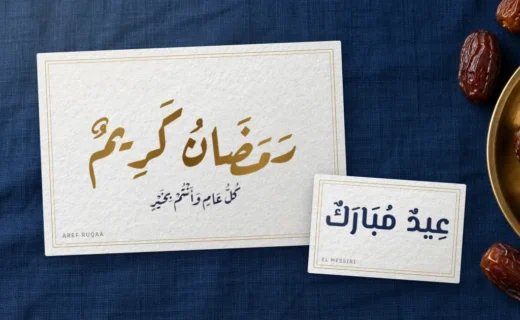
Ramadan Kareem in Arabic and Eid Mubarak: Spelling, Meaning, Lettering
Every Ramadan and Eid greeting with its exact Arabic spelling, vowel marks, meaning and reply, the Kareem or Mubarak debate, and free fonts tested… Read more : Ramadan Kareem in Arabic and Eid Mubarak: Spelling, Meaning, Lettering
Arabic Fonts in Canva: Find, Upload and Fix Them
Find the Arabic fonts Canva already has, upload a free Arabic font to your Brand Kit with the right files, and fix reversed, boxed… Read more : Arabic Fonts in Canva: Find, Upload and Fix Them
Arabic Text in Photoshop, Illustrator and InDesign: Setup Guide
Photoshop now shapes Arabic on its own; Illustrator and InDesign still need the right composer. Exact menu paths for direction, digits, diacritics and kashida,… Read more : Arabic Text in Photoshop, Illustrator and InDesign: Setup Guide
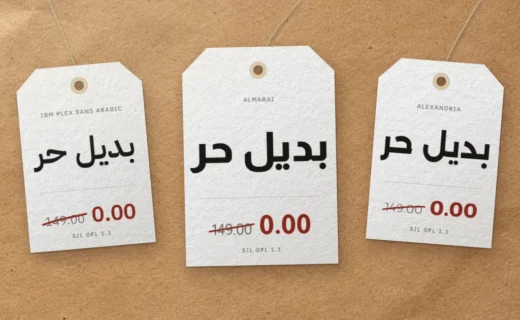
Free Alternatives to Commercial Arabic Fonts: GE SS, Dubai, DIN Next
GE SS Two, Dubai Font, DIN Next Arabic, Janna, 29LT Bukra, Hacen: who owns each one, what its license allows, and the open-licensed fonts… Read more : Free Alternatives to Commercial Arabic Fonts: GE SS, Dubai, DIN Next
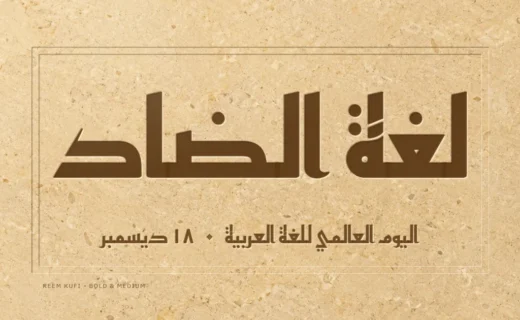
World Arabic Language Day: Why 18 December, Themes and Type Ideas
Why the UN chose 18 December, how UNESCO came to mark it, every recent theme checked at the source, and ways to celebrate through… Read more : World Arabic Language Day: Why 18 December, Themes and Type Ideas
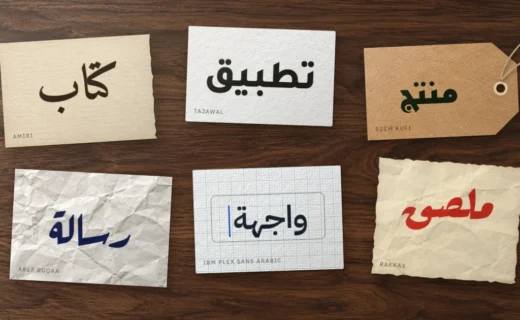
The Best Free Arabic Fonts in 2026: 12 Picks From 109 Tested
Twelve free Arabic fonts picked from 109 tested families: Amiri, Scheherazade New, IBM Plex Sans Arabic, Tajawal, Reem Kufi, Lalezar, Aref Ruqaa and more,… Read more : The Best Free Arabic Fonts in 2026: 12 Picks From 109 Tested