Ramadan Kareem in Arabic and Eid Mubarak: Spelling, Meaning, Lettering
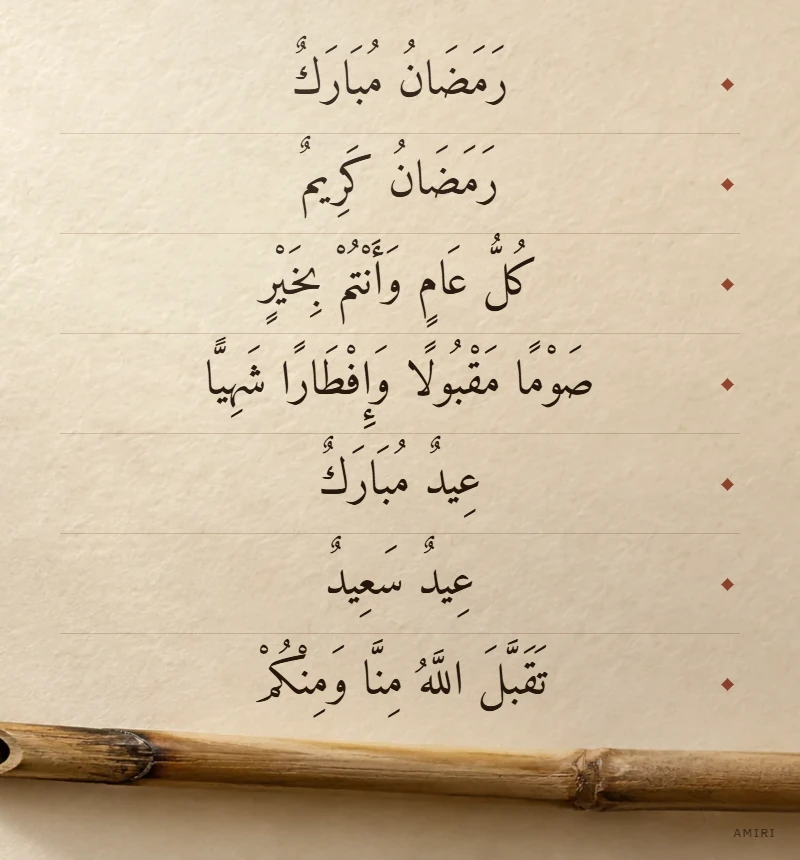
Ramadan Kareem in Arabic is written رمضان كريم, two words read from right to left: رمضان (Ramaḍān), the month of fasting, and كريم (karīm), “generous” or “noble”. Below you will find every common Ramadan and Eid greeting with its exact spelling, full vowel marks, meaning and usual reply, then how to letter it on a card or a story with free fonts that we tested on the same phrase.
Ramadan Kareem in Arabic, Eid Mubarak and the other greetings
Copy the Arabic column as it is. The vowel marks (حركات, harakat) are optional on a card, but if you keep them, keep all of them.
| Arabic | Transliteration | Meaning | When | Usual reply |
|---|---|---|---|---|
| رَمَضَانُ مُبَارَكٌ | Ramadan mubarak | Blessed Ramadan (literally “Ramadan is blessed”) | From the eve of Ramadan through the month | اللَّهُ يُبَارِكُ فِيكَ (Allah yubarik fik in everyday speech, “God bless you”) |
| رَمَضَانُ كَرِيمٌ | Ramadan karim | Ramadan is generous, noble | Same; very common in Egypt and the Levant | اللَّهُ أَكْرَمُ (Allahu akram, “God is more generous”) |
| مُبَارَكٌ عَلَيْكُمُ الشَّهْرُ | Mubarakun ‘alaykum ash-shahr | May the month be blessed for you | Start of Ramadan, especially in the Gulf | اللَّهُ يُبَارِكُ فِيكَ |
| صَوْمًا مَقْبُولًا وَإِفْطَارًا شَهِيًّا | Sawman maqbulan wa iftaran shahiyyan | May your fast be accepted and your iftar delicious | Late afternoon, before the fast is broken | A thank-you |
| كُلُّ عَامٍ وَأَنْتُمْ بِخَيْرٍ | Kull ‘am wa antum bi-khayr | May you be well every year | Start of Ramadan, both Eids, the new year | وَأَنْتُمْ بِخَيْرٍ (wa antum bi-khayr, “and you too”) |
| عِيدٌ مُبَارَكٌ | ‘Id mubarak | Blessed Eid | Eid al-Fitr and Eid al-Adha | عَلَيْنَا وَعَلَيْكُمْ (‘alayna wa ‘alaykum, “to us and to you”) |
| عِيدٌ سَعِيدٌ | ‘Id sa‘id | Happy Eid | Both Eids; a lighter, less religious tone | The same words |
| تَقَبَّلَ اللَّهُ مِنَّا وَمِنْكُمْ | Taqabbal Allahu minna wa minkum | May God accept it from us and from you | The days of Eid, after a month of fasting or the days of Hajj | The same words |
Two practical notes. أَنْتُمْ (antum) is the plural “you”, which also serves as a polite form; to one man write وَأَنْتَ بِخَيْرٍ, to one woman وَأَنْتِ بِخَيْرٍ. And “Eid” alone is عِيد; the two feasts are عِيدُ الْفِطْرِ (Eid al-Fitr, at the end of Ramadan) and عِيدُ الْأَضْحَى (Eid al-Adha, the feast of the sacrifice). Eid Mubarak works for both.
Spoken Arabic adds its own wishes. In Egypt you will hear كل سنة وانت طيب (kull sana w-inta tayyib), in the Levant ينعاد عليكم (yin‘ad ‘alaykum, “may it come back to you”). They are warm and natural in a message, but on a printed card meant for many readers, the standard forms in the table travel best.
Ramadan Kareem or Ramadan Mubarak?
Both are correct Arabic. The question is religious, not grammatical, and it divides opinion.
The objection. The Saudi scholar Muhammad ibn al-Uthaymin was asked about people who excuse a lapse during the fast with “Ramadan Kareem”. He answered that the phrase is not correct and that one should say “Ramadan Mubarak” instead: generosity belongs to God, who gave the month its merit; the month itself gives nothing. His answer is collected in volume 20 of his fatwas and reproduced, for example, by Alukah (in Arabic). Supporters of “Mubarak” also point to the hadith reported by al-Nasa’i in which the Prophet announces Ramadan as شَهْرٌ مُبَارَكٌ (shahrun mubarak, “a blessed month”).
The other reading. In Arabic, كَرِيم also means noble, precious, rich in good things. The Quran itself uses it this way, for example إِنَّهُ لَقُرْآنٌ كَرِيمٌ (“it is a noble Quran”, 56:77). Those who use the phrase read it this way: it praises the month without attributing to it what belongs to God. It remains one of the most common greetings in the Arab world.
Our advice for a design. If the card goes to a varied or unknown audience, a company’s customers for instance, write رمضان مبارك: nobody objects to it. If you are writing to people who say “Ramadan Kareem” themselves, use their phrase. The greeting is for them.
Getting the vowel marks right
A greeting without harakat is perfectly normal Arabic. Marks become a problem only when they are wrong, and on a large card a wrong mark is very visible. Five points cover almost every case.
- Ramadan never takes tanwin. As a proper name ending in -ān, رَمَضَانُ belongs to the nouns that refuse nunation. Write a single damma on the last letter, never رمضانٌ.
- The adjective does take it. In رَمَضَانُ كَرِيمٌ or عِيدٌ مُبَارَكٌ, the indefinite word ends in a double damma (tanwin, the “-un” ending).
- Accusative wishes end in a double fatha. In صَوْمًا مَقْبُولًا the mark sits on the letter before the final alif, the usual modern practice. Some writers put it on the alif; pick one habit for the whole design.
- Do not drop the shadda. The doubling mark carries meaning in كُلُّ, تَقَبَّلَ, مِنَّا and شَهِيًّا, and in the name of God, اللَّه.
- Write the hamza. أَنْتُمْ starts with a hamza above the alif, إِفْطَار with a hamza below. Plain انتم is a common slip in typed greetings.
To type the marks without an Arabic layout, open our online Arabic keyboard with harakat, switch to direct mode and click fatha, damma, kasra, sukun, shadda or a tanwin in the diacritics row after each letter. Check the result against the table, letter by letter, before you paste it into your design app.
When to send them in 2027
The Islamic calendar is lunar, so each date depends on the sighting of the new crescent and can differ by a day between countries. The figures below are projections published by the UAE’s Astronomy Centre and reported by Khaleej Times; confirm them with your local mosque or community.
- Ramadan 1448 is expected to begin on or around Monday, February 8, 2027. Some countries may start on February 9.
- Eid al-Fitr is expected on Tuesday, March 9 or Wednesday, March 10, 2027.
- Eid al-Adha is expected on Sunday, May 16 or Monday, May 17, 2027.
Ramadan greetings are most common from the last days before the month through its first week, though they are welcome all month. Eid greetings run from the eve through the days of the feast. If your artwork carries a date, prepare two versions, or leave the date off.
Fonts we tested on the same greeting
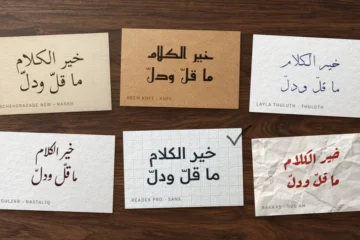
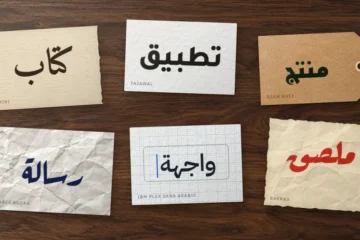
This section covers lettering one greeting well. For the full catalog selection, browse our free fonts for Ramadan and Eid designs.
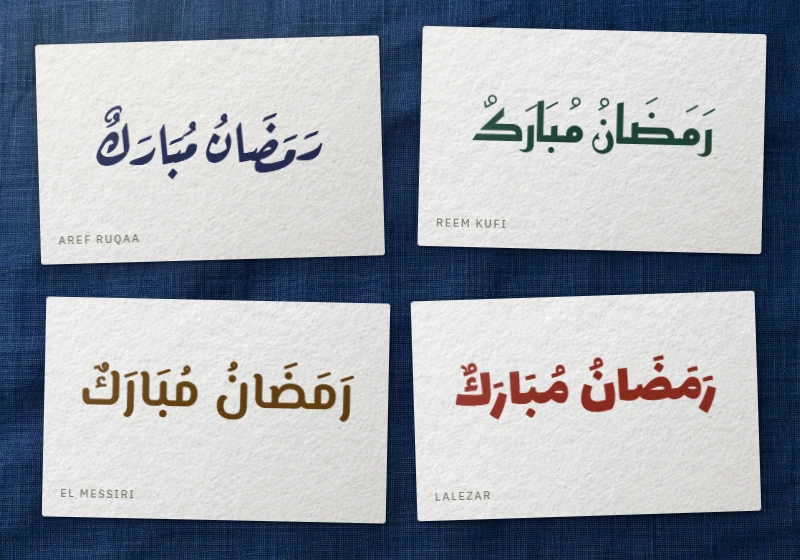
How we tested. We set three fully vocalized phrases, رَمَضَانُ كَرِيمٌ, عِيدٌ مُبَارَكٌ and تَقَبَّلَ اللَّهُ مِنَّا وَمِنْكُمْ, at 52 px in Chrome, in fifteen fonts from our catalog, using the same files the site serves. A script first checked that each file contains every mark we needed: fatha, damma, kasra, sukun, shadda and the three tanwins. Then we looked at what a reader sees: do the letters stay joined around a shadda, do the marks collide, does the name of God keep its ligature, and does the phrase still read at story-thumbnail size? When a font misbehaved, we repeated the test with its original TTF to rule out our own conversion.
| Font | Style | Weights | License | Best for |
|---|---|---|---|---|
| Aref Ruqaa | Ruq’ah | Regular, Bold | OFL 1.1 | Family cards, short wishes that should look handwritten |
| Reem Kufi | Kufi | 400 to 700 | OFL 1.1 | Modern posters, a mosque or association banner |
| El Messiri | Display | 400 to 700 | OFL 1.1 | Elegant cards; Ramadan Kareem, Eid Mubarak |
| Lalezar | Display | Regular only | OFL 1.1 | Store banners, promotions, headlines seen from afar |
| Amiri | Naskh | Regular, Bold | OFL 1.1 | Fully vocalized text, du‘a, verses, the second line of a card |
Aref Ruqaa is the one we chose for our cover card and for the Eid card below. It follows Ruq’ah, the everyday handwriting of much of the Arab world, so a greeting set in it reads as a personal note rather than as print. Every mark landed in the right place, including the double damma of كَرِيمٌ, and the name of God kept its ligature. Use Bold for the greeting and Regular for a smaller line.
Reem Kufi brings the angular rhythm of early Kufi. It suits a bold, modern design and a short phrase. Its marks are small and neat; at story size, drop them or enlarge the text.
El Messiri has round, open forms and generous spacing between marks, and it set our three phrases cleanly. Our test of all 109 families on 26 October 2026 found its weak spot: on a final lam, as in كُلُّ (kullu), the shadda and its vowel come loose and float beside the letter, in the original file as in our web file. Use it for رَمَضَانُ كَرِيمٌ or عِيدٌ مُبَارَكٌ, and set كُلُّ عَامٍ وَأَنْتُمْ بِخَيْرٍ, like any longer vocalized text, in Amiri.
Lalezar is the loud option: heavy, compact strokes inspired by Iranian film posters of the 1960s and 1970s. The marks render correctly but sit tight against the letters, so use it large and keep the vocalized details for another font.
Amiri is the reference when vowels matter: a book Naskh that stacks marks cleanly, even around a shadda. Pair it with any of the four above for the second line, as in the story and card below.
Install the five fonts before you design: our guide on installing Arabic fonts on Windows, macOS and Linux covers it. If you are making a Ramadan card in Canva, upload them to a Brand Kit instead. Canva takes static files only: Aref Ruqaa, Lalezar and Amiri upload as downloaded, while Reem Kufi and El Messiri come as variable files and need their static versions.
What did not pass. Lemonada, otherwise a friendly display face, detached the shadda and its vowel from the letter at every shadda in our test (تَقَبَّلَ, مِنَّا, اللَّه): the marks take a space of their own, which breaks the join and splits the word, in our web file and in the original version 4.005 alike. Keep it for unvocalized text. Qahiri’s marks crowd its compact Kufi letters; use it for bare words.
Thuluth and Diwani, the styles of ceremonial calligraphy, are a different case. Our catalog has three fonts in those styles, Layla Thuluth, Tholoth and Layla Diwani, but they set the letters on a single line, and the two Layla files place every mark at a fixed height: keep them for a bare word. Layla Diwani’s restricted embedding flag will likely block a Canva upload and Word embedding: export the title as an image. The stacked, flowing compositions you see on ceremonial cards are drawn by hand for each phrase; for that look, commission a calligrapher.
Laying out a card or a story
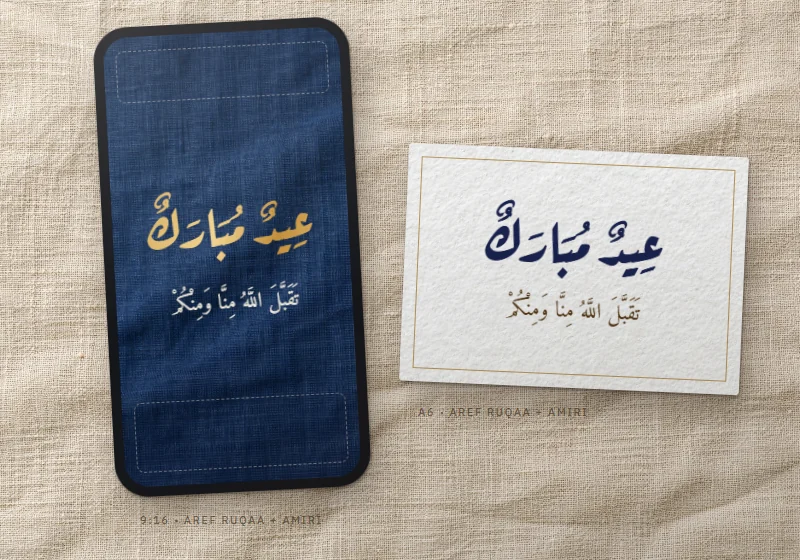
- One greeting, one hero. Set the main phrase large, in one display font. Put any second phrase, a name or a date in a calmer face such as Amiri, at about a third of the size.
- Give the marks room. Harakat need vertical space: a line height of 1.6 to 1.8 keeps the marks of one line clear of the next. Check the descending kasra and the hamza below the alif.
- Story, 9:16. Work at 1080 × 1920 px. Keep the text away from the top and bottom bands, where the app overlays the account name and the reply field, and read it on a real phone before you post.
- Printed card. A6 (105 × 148 mm) is a common greeting-card size. Ask your printer for its bleed and safe-margin rules, and keep fine marks out of any foil or embossed area unless the printer confirms they will hold.
- Contrast. Gold on cream looks rich in print and weak on screen. On a story, use a light gold on a dark ground, or dark ink on a light one.
- No tracking, no fake italics. Letter-spacing pulls Arabic letters apart, and slanted text breaks the line of the writing. To stretch a word, use the font’s own design or a different weight.
Still unsure between a solemn and a festive voice? Our method for choosing an Arabic font by tone and audience applies to a single card as well.
Mistakes that ruin a greeting
- Letters separated or running left to right. The app is not shaping Arabic. Recent design tools do it natively: Photoshop has shaped Arabic with its Unified Text Engine since version 23.0 (October 2021), according to Adobe’s documentation. Older versions and some mobile video apps still break the words. Our guide to Arabic letters that will not connect gives the fix app by app.
- “Fixing” it with a text reverser. Reverser websites output Arabic presentation forms, characters that the Unicode FAQ describes as encoded for compatibility only. The result is no longer searchable or editable text, and it shows backwards as soon as the app supports Arabic. Change the app instead.
- Letter-by-letter transliteration. Typing every Latin “a” as an alif gives رامادان كاريم, which is not Arabic. Copy the spelling from the table.
- Mabrouk instead of mubarak. مبروك (mabruk) is the everyday spoken form, common for weddings and success and, in North Africa, for Eid too. On a card in standard Arabic, مبارك is the safer choice.
- Marks on the wrong letter. A tanwin on رمضان, a missing shadda in تقبّل, or marks colliding with an ornament. Proof the final export at 100 percent.
- The wrong occasion. Eid Mubarak belongs to the feast at the end of Ramadan or to Eid al-Adha, not to the first night of the fast.
FAQ
How do you reply to Eid Mubarak?
With the same words, or with عَلَيْنَا وَعَلَيْكُمْ (“to us and to you”). تَقَبَّلَ اللَّهُ مِنَّا وَمِنْكُمْ is also a fitting answer on Eid day.
Is Ramadan Mubarak correct Arabic?
Yes. رَمَضَانُ مُبَارَكٌ means “Ramadan is blessed”, and it is the form nobody disputes.
Can I use these fonts for a store’s Ramadan campaign?
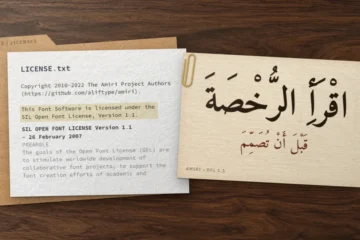
Yes. All five fonts in the table are under the SIL Open Font License 1.1, which allows commercial use in printed and digital designs. What it forbids is selling the fonts by themselves. If you pass the font files on, to a printer or in a shared folder, include the license file from the download.