Arabic Font Licenses Explained: OFL, Apache, System Fonts and EULAs
An Arabic font license is the set of terms that come with the font file. It decides whether you can put the font in a logo, serve it from your own server, embed it in an app or hand it to a client. This guide reads the actual license texts (the SIL Open Font License, Apache 2.0, the GPL font exception, the Windows and macOS terms, a foundry EULA and a reseller’s licensing FAQ) and turns them into one comparison table and a use-by-use guide. It is information, not legal advice: when a project is large, the license text and a lawyer have the last word.
What an Arabic font license covers
A font is software. Its license governs the file: installing it, copying it, converting it, embedding it, modifying it, selling it. It does not, as a rule, govern the text you set with it. The poster, the PDF report or the packaging you design stays yours under the free licenses, and most commercial EULAs treat a printed page or a static image the same way.
Two fields in a font file are easy to confuse. The copyright notice says who owns the design. The license says what you may do with it. Open Tajawal and the copyright field reads “(c) 2017 by Boutros International. All rights reserved.” That sounds closed. The license field (name ID 13) of the same file says the font is licensed under the SIL Open Font License 1.1. Both are true: Boutros owns the design and grants everyone the OFL rights. Never judge a font by its copyright line alone.
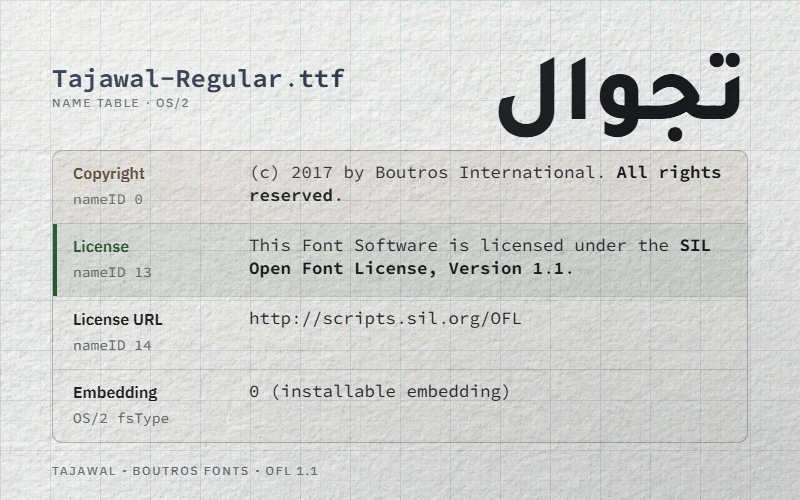
Where to read the license, from the most to the least reliable:
- The license file in the download:
OFL.txt,LICENSE.txtorLICENSE. Every font in our catalog ships one inside its zip. - The font’s own name table: name ID 13 (license description) and name ID 14 (license URL). With the free
fonttoolspackage installed,ttx -q -t name -o - Tajawal-Regular.ttfprints them in a terminal. - The download page. Useful, but it is the least reliable: a mirror site can write anything.
You will also meet the embedding flag (fsType in the OS/2 table), which tells Word or Acrobat whether the font may travel inside a document; Apple’s license points to the info panel of Font Book or Preview to see it. It is a technical flag, not a license: it never grants rights.
OFL, Apache and GPL: the free licenses
Free here means libre: you get the right to use, study, modify and share, not only a zero price. Three licenses cover nearly every free Arabic font you will meet, and as of October 2026 our catalog uses all three: 92 families under the OFL, 15 under the GPL with font exception and 2 under Apache 2.0.
SIL Open Font License 1.1
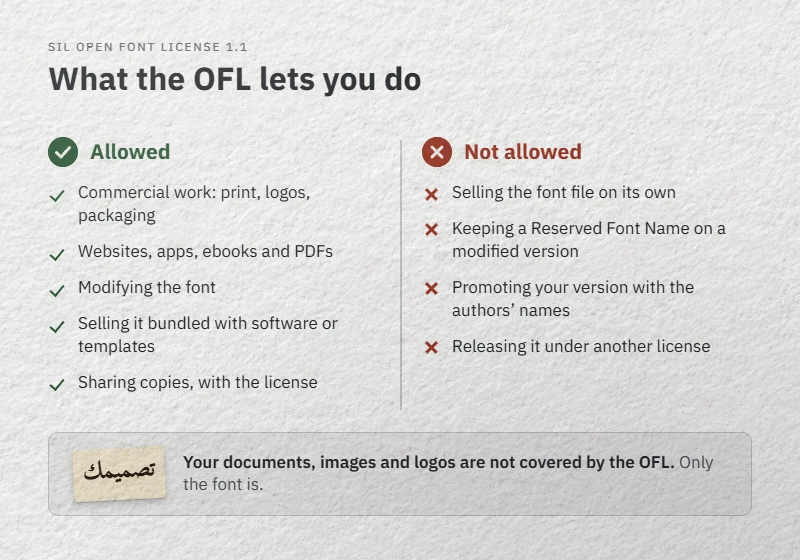
The OFL 1.1 was written for fonts, which is why most Arabic type projects use it: Amiri, Cairo, Tajawal, IBM Plex Sans Arabic, Noto and the SIL families among them. It grants the right to “use, study, copy, merge, embed, modify, redistribute, and sell modified and unmodified copies” under five conditions:
- The font may not be sold by itself. Selling a template, a game or an app that includes the font is allowed.
- Each copy you distribute keeps the copyright notice and the license, as a text file or in readable metadata.
- A modified version may not use a Reserved Font Name without written permission.
- The authors’ names may not be used to promote a modified version.
- The font stays under the OFL. That requirement “does not apply to any document created using the Font Software”.
Condition 3 is the one designers miss. A Reserved Font Name is declared right after the copyright line, and it can be inherited from a Latin parent. IBM Plex Sans Arabic reserves “Plex”. Scheherazade New reserves “Scheherazade” and “SIL”. Reem Kufi reserves “Josefin Sans”, the Latin it builds on. Amiri, Cairo and Tajawal reserve no name. If you add glyphs to a font that has one, your version needs a new name.
The official OFL FAQ settles the questions that come up in agencies. Logos are an expected use (FAQ 1.1). Embedding a font, in full or as a subset, in a PDF or another document is allowed (1.12). An app that bundles the font must carry the copyright and license (1.20). For webfonts, it treats format conversion and subsetting as modifications (2.2 and 2.6): with a font that has a Reserved Font Name, either serve the original data compressed as WOFF2 and otherwise unchanged (2.2.1), or rename your subset.
Apache License 2.0
Apache 2.0 is a general software license that some fonts use. In our catalog it covers Droid Arabic Naskh and Droid Arabic Kufi, drawn by Pascal Zoghbi. It is as permissive as the OFL in practice, with four differences worth knowing. Selling the font on its own is allowed. There is no copyleft: a modified version does not have to stay under Apache, whereas OFL condition 5 keeps derivatives under the OFL. Redistribution must include a copy of the license, keep the existing notices and mark the files you changed (section 4). And it grants no right to the licensor’s trademarks (section 6): the Droid files themselves state that “Droid is a trademark of Google”.
GPL with font exception, and why AGPL fonts stay out
Some older Arabic fonts use the GNU GPL. Without more, a GPL font embedded in a PDF could arguably pull the PDF under the GPL. The font exception published by the Free Software Foundation removes that doubt: embedding the font in a document “does not by itself cause the resulting document to be covered” by the GPL. The font file itself stays under the GPL, so distributing it (on a server, in an app, to a client) brings the usual duties: the license text and the source, or a written offer of it (GPLv2 section 3, GPLv3 section 6). Our rule is simple: GPL with that exception, yes; plain GPL, no. In our catalog the exception covers 15 families: ten from the Arabeyes project, such as Tholoth; FreeSerif and FreeMono, from GNU FreeFont; and three PakType families, among them PakType Naqsh.
The AGPL is a different case. It was written for server software and carries no font exception. Several Kufic revivals by Alif Type are published under AGPL-3.0, Raqq among them. We cite them with a link to their source repository, but we do not host them: the license’s effect on a web page or an ebook that embeds the font is not settled, and our visitors need fonts they can use without that question.
Two more you may meet. The Ubuntu Font Licence works much like the OFL, with naming rules for modified versions. Creative Commons licenses sometimes appear on hobby fonts; Creative Commons itself recommends against using them for software, and we turn down fonts under Creative Commons licenses.
Are Google Fonts free for commercial use?
Yes. The Google Fonts FAQ says they can be used commercially, inside products that are sold, in logos and on any surface. Each family keeps its own license (OFL in most cases, some Apache or Ubuntu Font Licence), so the conditions above still apply when you redistribute the files.
Arabic font licenses compared, right by right
Read each column as the license as written. A commercial EULA varies by foundry and by license type, so the Commercial EULA column describes the usual pattern, not a promise.
| Right | OFL 1.1 | Apache 2.0 | GPL + font exception | Windows fonts | macOS fonts | Commercial EULA | “Personal use” |
|---|---|---|---|---|---|---|---|
| Commercial print, packaging, posters | Yes | Yes | Yes | Yes | Display and print granted | Desktop license | No |
| Logo and brand mark | Yes | Yes | Yes | Yes | Not addressed | Desktop license at minimum | No |
| Self-hosted webfont | Yes | Yes | Yes, with license and source | No | No | Web license, by page views | No |
| Bundled in an app or game | Yes, with license | Yes, with license | Yes, with license and source | No | No | App license, by title | No |
| Embedded in a PDF | Yes | Yes | Yes | Per embedding flag | Per embedding flag | Usually locked PDF; ebooks need their own license | Private only |
| Modify the font | Yes, rename if a name is reserved | Yes, mark changes | Yes, stays GPL | No | No | No | No |
| Give the files to a client or printer | Yes, with license | Yes, with license | Yes, with license and source | No | No | Client buys its own; printer for the job only | No |
| Sell the font file alone | No | Allowed | Allowed, under GPL | No | No | No | No |
Which license for which use
Start from what you are making, then follow the branch.
- A logo or brand identity. Any OFL, Apache or GPL font with the font exception works; see Arabic fonts for logos and branding. Commercial font: a desktop license is the minimum, and the EULA must not exclude logos. A trademark protects your mark, not the typeface, so a competitor may still use the same font. Personal-use font: no.
- Print: flyers, books, packaging. Free fonts, Windows fonts and desktop-licensed fonts are fine. Send the printer a PDF with fonts embedded rather than the font files.
- A website. Self-hosting needs a license that allows serving the file: OFL, Apache, the GPL with font exception (serve the source too, or a written offer of it) or a paid web license. Windows and Mac fonts can only be named in your CSS font stack, never uploaded.
- Uploading to Canva or an online editor. OFL and Apache fonts can be uploaded, and so can GPL fonts with the font exception. A commercial desktop license often cannot: the MyFonts FAQ says none of the licenses it sells allows uploading fonts to Canva, because the desktop EULA limits use to licensed computers. Read the EULA before you upload. Our guide to Arabic fonts in Canva covers the upload itself.
- A mobile app or a game. OFL or Apache, with the license text in the app’s credits or files. A GPL font with the font exception also needs its source, or a written offer of it, since the font file itself ships with the app. Commercial fonts need an app license per title. System fonts are excluded, even converted to bitmaps.
- An ebook or interactive PDF. Free fonts embed freely. Commercial fonts often require an ePub or electronic document license counted per publication.
- Video, TV, streaming. Free fonts are fine. Microsoft treats captions rendered as images like graphic files. Some foundries sell a separate broadcast license for titles and on-screen graphics.
- A product that contains the font (a template, a theme, a game). OFL bundling is allowed as long as the license travels with it. Selling the font file alone is not.
Commercial EULAs: how they are metered
Commercial Arabic families are sold under an end user license agreement (EULA). Prices change, so we do not quote them. The structure is stable, and two sources show it well.
29LT, the Arabic and Latin foundry founded by Pascal Zoghbi (the designer of the free Droid Arabic fonts), publishes its EULAs in full. As of October 2026, they read:
- Desktop: installation on the number of computers on the invoice. If the client needs the font, the client buys its own license. A printer may use a copy for the job, then must delete it.
- Web: a number of page views per month, for one domain. A page view is any page load that references the font through
@font-face. Exceed the limit three months in a row and you need the next tier. - App and ePub: counted by title, whether the title is an app, a game or an ebook.
- Broadcasting: TV, cinema and streaming content.
- Corporate: one bundle by company size. The smallest tier covers 10 computers, 100,000 views a month and one app or title.
The desktop EULA also forbids converting the font to other formats and embedding it in any document that lets the recipient edit or extract it. That is why “export a locked PDF” is the safe hand-off.
The MyFonts FAQ follows the same pattern for the families it resells: desktop licenses by number of users, webfont licenses for one domain and a monthly page-view tier, electronic document licenses by number of publications, separate licenses for apps, digital ads and servers. It also states that a logo needs a desktop license at minimum. If those terms do not fit the budget, our list of free alternatives to commercial Arabic fonts suggests open-licensed replacements for the most common retail families.
Windows and Mac fonts
Fonts that came with your system feel free. They are licensed, with narrower rights than the OFL.
Windows: Traditional Arabic and other system fonts
Microsoft’s font redistribution FAQ (updated November 2024) is clear. You may print, sell what you print, make logos and graphic files, and put captions in videos as rendered images, unless your app is licensed for home, student or non-commercial use only. Word and PowerPoint may embed the fonts in documents and PDFs according to each font’s embedding flag. You may not copy the fonts to a web server, convert them to WOFF or WOFF2, put them in an app, game or device, or modify them. Extended rights are sold by Monotype or by the foundry named in the font’s properties. The same rules cover Simplified Arabic, Arial and every other font installed with Windows.
Traditional Arabic is a good example of who owns what. Microsoft’s Traditional Arabic page credits the copyright to The Monotype Corporation, names Glyph Systems as vendor, and marks it as exclusively included with Microsoft products. Its design follows the metal Naskh of the Amiriya Press in Bulaq, the same source that Amiri revives under the OFL. If you need that look on a website or in an app, Amiri is the free, self-hostable route.
macOS: Geeza Pro, Baghdad, Damascus
Apple lists the Arabic families included with macOS Tahoe in its font list for that version: Geeza Pro, Baghdad, Damascus, Al Bayan, Al Nile, Diwan Thuluth, Mishafi, Muna, Sana and others. The macOS Tahoe license (section 2.E) lets you use them “to display and print content” while running macOS, and to embed them in content only where the font’s embedding restrictions allow. It grants nothing else: no web hosting, no app bundling, no redistribution, and nothing explicit about logos.
Pirated fonts and “free for personal use”
Arabic download sites carry three kinds of trap.
- Repackaged commercial fonts. Retail Arabic families circulate renamed, “shared” on forums or offered as “free downloads”. Liability can reach whoever publishes the logo, the app or the book, not only the site. Check the name table: if the copyright or vendor field names a foundry, the license field names no open license, and the page you downloaded from is not that foundry or its reseller, stop.
- “Free for personal use”. Usually a trial right: mock-ups, private projects. A client logo, a product, a monetized video or an ad is commercial use and needs the paid license.
- No license at all. A font with no license anywhere (no license file, nothing in the name table) is not a free font. It is a font whose terms you do not know.
The rule we apply to our own catalog is the one we suggest for yours: no license file from the official source, no use in client work. Our tested selection of free Arabic fonts only includes fonts that pass it.
A five-minute check before you ship
- Find the license (file or name table) and name it: OFL, Apache, GPL with font exception, or a named EULA.
- Compare the source with the official one: the designer’s repository, the foundry, Google Fonts.
- Read the first lines for a Reserved Font Name if you plan to modify or subset.
- Match the use to the license: desktop, web, app, ebook, broadcast. A commercial font needs a license for each type of use.
- Keep the license next to the project files and hand it over with them.
Choosing the font itself is a separate step. Our guide on how to choose an Arabic font covers style, legibility, harakat and pairing.
FAQ
Can I use an OFL font in a trademarked logo?
Yes. The OFL FAQ lists logos as an intended use, and the license does not reach the documents or artwork you create. What you register is your mark. You gain no exclusive right over the typeface, so outline and adjust the lettering if the logo must feel unique.
Do I have to credit the font designer?
Not under the OFL and Apache, and not in the artwork: the OFL FAQ says authors may appreciate a credit. Some freeware licenses do require one. When you distribute the font file itself (in an app, a template or a website’s font folder), the copyright notice and the license must travel with it.
Can I sell a design template that includes an OFL font?
Yes, if the font is bundled with the template and keeps its license. What the OFL forbids is selling the font on its own, for instance as a paid download of the file.