The Arabic Alphabet: 28 Letters, Their Forms and How They Join
The Arabic alphabet is a set of 28 letters that join into words, change shape with their position and leave most vowels unwritten. Learn the 28 basic shapes, the joining rule and the dot patterns, and you can identify every letter of any printed Arabic word, even before you know what it means. This guide covers all three, with ALA-LC transliteration, IPA pronunciation and a chart you can print.
The 28 letters: Arabic alphabet chart
The table follows the hijāʼī order used in modern dictionaries and school books. Read each row from the isolated form to the final form. The joined forms are shown with a tatweel (ـ), the short connecting stroke textbooks use to show where a letter attaches. Transliteration follows the ALA-LC romanization table (Library of Congress, 2012 version), the standard in English-language libraries and much academic writing; IPA gives the Modern Standard Arabic sound.
| Name | Isolated | Initial | Medial | Final | ALA-LC | IPA |
|---|---|---|---|---|---|---|
| alif | ا | ا | ـا | ـا | ā (vowel) | aː |
| bāʼ | ب | بـ | ـبـ | ـب | b | b |
| tāʼ | ت | تـ | ـتـ | ـت | t | t |
| thāʼ | ث | ثـ | ـثـ | ـث | th | θ |
| jīm | ج | جـ | ـجـ | ـج | j | d͡ʒ |
| ḥāʼ | ح | حـ | ـحـ | ـح | ḥ | ħ |
| khāʼ | خ | خـ | ـخـ | ـخ | kh | x |
| dāl | د | د | ـد | ـد | d | d |
| dhāl | ذ | ذ | ـذ | ـذ | dh | ð |
| rāʼ | ر | ر | ـر | ـر | r | r |
| zāy | ز | ز | ـز | ـز | z | z |
| sīn | س | سـ | ـسـ | ـس | s | s |
| shīn | ش | شـ | ـشـ | ـش | sh | ʃ |
| ṣād | ص | صـ | ـصـ | ـص | ṣ | sˤ |
| ḍād | ض | ضـ | ـضـ | ـض | ḍ | dˤ |
| ṭāʼ | ط | طـ | ـطـ | ـط | ṭ | tˤ |
| ẓāʼ | ظ | ظـ | ـظـ | ـظ | ẓ | ðˤ |
| ʻayn | ع | عـ | ـعـ | ـع | ʻ | ʕ |
| ghayn | غ | غـ | ـغـ | ـغ | gh | ɣ |
| fāʼ | ف | فـ | ـفـ | ـف | f | f |
| qāf | ق | قـ | ـقـ | ـق | q | q |
| kāf | ك | كـ | ـكـ | ـك | k | k |
| lām | ل | لـ | ـلـ | ـل | l | l |
| mīm | م | مـ | ـمـ | ـم | m | m |
| nūn | ن | نـ | ـنـ | ـن | n | n |
| hāʼ | ه | هـ | ـهـ | ـه | h | h |
| wāw | و | و | ـو | ـو | w, ū | w, uː |
| yāʼ | ي | يـ | ـيـ | ـي | y, ī | j, iː |
Two remarks on the ALA-LC column. Alif carries no consonant of its own: it writes the long vowel ā or supports a hamza, which ALA-LC drops at the start of a word. And ALA-LC writes hamza and ʻayn with two small signs, ʼ and ʻ, the two most often lost when text is retyped: “Ali” and “ʻAlī” are the same name, but only the second tells you it starts with ʻayn.
Four forms and how the letters join
Arabic has no separate print and cursive: the letters of a word join wherever they can, like handwriting. Each letter therefore has up to four shapes. The initial form opens a chain, the medial form sits inside it, the final form closes it, and the isolated form stands alone. You never choose the form yourself: you type the letter, and the font and the text engine pick the shape.
Take بيت (bayt, house). It is three letters, all joining: بـ + ـيـ + ـت. Read from the right, the bāʼ opens the chain, the yāʼ links both sides, the tāʼ closes it. Most of the change happens at the edges of a letter: the initial bāʼ loses the tail of its isolated bowl, and the final tāʼ keeps it.
The six letters that never join forward
Six letters connect to the letter before them but never to the letter after: ا (alif), د (dāl), ذ (dhāl), ر (rāʼ), ز (zāy) and و (wāw). After one of them, the next letter starts a new chain, so a single word can break into several pieces. That is why these six have only two distinct shapes, and why their “initial” form is the same as their isolated one.
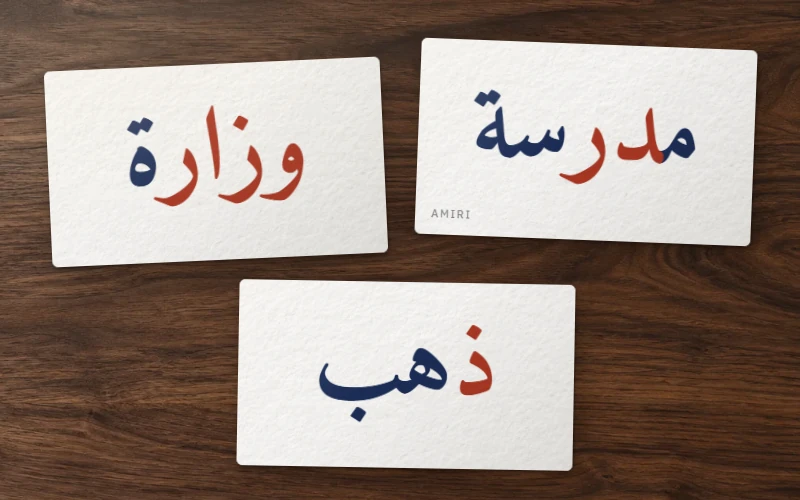
- مدرسة (madrasah, school): mīm joins dāl, but dāl cannot reach the rāʼ, and rāʼ cannot reach the sīn. The word falls into three pieces: مد, ر, سة.
- وزارة (wizārah, ministry): wāw, zāy, alif and rāʼ are all non-joining, so every letter stands apart, including the final tāʼ marbūṭah.
- كتاب (kitāb, book): kāf and tāʼ join the alif, then the alif stops the chain and the bāʼ is written in its isolated form.
For a learner, the six letters are the key to reading spacing correctly: a gap inside a word is not a word break. For a designer, they explain why Arabic words have an irregular rhythm of joined clusters, and why a word broken into isolated letters on screen is a rendering bug, not a style. If you see it on your screen, here is how to fix Arabic letters not connecting in your software.
Lam-alif, the compulsory ligature
When lām is followed by alif, the two merge into one shape: لا (lā, “no”). It is not optional, and every Arabic font must provide it. You see it in the middle of سلام (salām, peace): sīn, then the lam-alif, then a mīm that stands alone because alif does not join forward. Some school charts insert لا near the end of the list as if it were an extra letter; it is two letters, typed as two keys.
Letter families: same skeleton, different dots
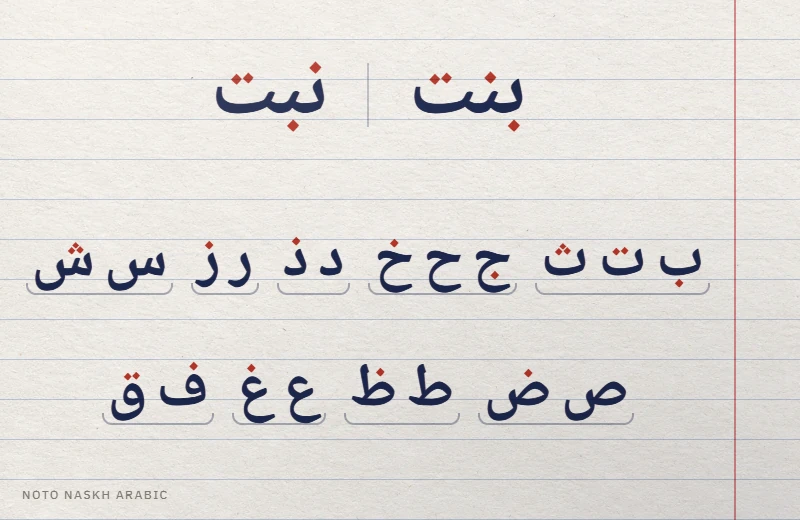
Strip the dots away and the 28 letters shrink to far fewer base shapes. The dots are called إعجام (iʻjām), and the dotless skeleton is known as the رسم (rasm). Thirteen letters have no dots at all; the other fifteen are told apart by them. Learning by family makes the shapes easier to memorize: once you know the skeleton, you only count dots and check whether they sit above or below.
| Skeleton | Letters | What changes |
|---|---|---|
| bowl or tooth | ب ت ث | one dot below, two above, three above |
| same tooth, joined forms only | نـ يـ | one dot above, two below; their isolated forms differ |
| open hook | ج ح خ | dot inside, none, dot above |
| small angle | د ذ | none, one above |
| descending curve | ر ز | none, one above |
| three teeth | س ش | none, three above |
| closed loop | ص ض | none, one above |
| loop with stem | ط ظ | none, one above |
| open curl | ع غ | none, one above |
| small loop | ف ق | one above, two above (qāf’s final bowl is also deeper) |
Five letters share the same tooth at the start or in the middle of a word: بـ تـ ثـ نـ يـ. It is a common trap for beginners. One regional exception: Maghribi script, used in North African Qurans, dots fāʼ below and qāf with a single dot above; even the ALA-LC table has a note for these two forms.
Pronunciation: the sounds English lacks
About half the alphabet sounds like English: b, t, d, z, s, sh, f, k, l, m, n, h, w, y. The r is close too, but tapped or rolled with the tongue tip, as in Spanish pero. Two more exist in English but are spelled with the same “th”: ث is the th of think, ذ the th of this. ج is the j of jam in standard Arabic; Cairo says a hard g, much of the Levant the s of measure. The real work is in nine letters:
| Letter | What to do |
|---|---|
| ح ḥāʼ | A strong, breathy h from the middle of the throat, like fogging a pair of glasses, with no scrape. |
| خ khāʼ | The ch of Scottish loch or German Bach: air scraping at the back of the mouth. |
| ع ʻayn | A squeeze of the throat muscles, voiced. Hum, then tighten the throat as if starting to gag. No English sound is close. |
| غ ghayn | The voiced partner of khāʼ, close to a French or German r: a soft gargle. |
| ق qāf | A k made further back, against the uvula. In Cairo and Beirut it often becomes a glottal stop; in the Gulf, a g. |
| ص ض ط ظ | The four emphatics: s, d, t and the th of this, said with the back of the tongue raised. They darken the vowels around them: compare سيف (sayf, sword) with صيف (ṣayf, summer). |
The pairs h and ḥ, k and q, s and ṣ are never interchangeable: changing one changes the word.
Hamza, ta marbuta, alif maqsura: 28 or 29 letters?
How many letters are in the Arabic alphabet? Twenty-eight. You will still see “29” on some charts, which count the hamza separately or add lam-alif. Three extra signs are not counted as letters but appear on every page:
- Hamza ء marks a glottal stop, the catch in “uh-oh”. It sits alone or on a carrier: أ and إ on alif, ؤ on wāw, ئ on a dotless yāʼ. Examples: سماء (samāʼ, sky), سؤال (suʼāl, question), بئر (biʼr, well). Which carrier to use is a spelling rule of its own, beyond the alphabet.
- Tāʼ marbūṭah ة, a hāʼ with two dots, appears only at the end of a word, mostly feminine nouns. Pronounced -a at a pause, -at when the word is linked to the next: مدرسة (madrasah), but وزارة التربية (Wizārat al-Tarbiyah, Ministry of Education), an example taken from the ALA-LC rules.
- Alif maqṣūrah ى looks like a yāʼ without dots and also ends words. It is read as a long ā: مصطفى (Muṣṭafá), على (ʻalá, on). ALA-LC writes it á to keep it distinct from alif.
Egyptian print often drops the dots of a final yāʼ, so ى and ي look identical there. Keep that in mind before “correcting” a text.
Sun and moon letters
The definite article ال (al-) is always written the same way, but its l is not always pronounced. Before 14 “sun letters”, it merges into the next consonant: الشمس is said ash-shams (the sun). Before the 14 “moon letters”, it stays: القمر, al-qamar (the moon). The two words gave the groups their names.
- Sun letters: ت ث د ذ ر ز س ش ص ض ط ظ ل ن
- Moon letters: أ ب ج ح خ ع غ ف ق ك م ه و ي (the first is alif carrying a hamza)
The sun letters are all made with the front of the tongue, where the l is made too, which is why it assimilates. ALA-LC keeps the spelling, al-shams; phonetic transcriptions write ash-shams. Both are correct for their purpose.
Short vowels, in brief
The 28 letters write consonants and long vowels. Short vowels are small marks, the حركات (ḥarakāt): fatḥah ـَ (a), kasrah ـِ (i), ḍammah ـُ (u), plus sukūn ـْ (no vowel) and shaddah ـّ (doubled consonant). The verb كَتَبَ (kataba, he wrote) shows three fatḥahs. Newspapers, signs and most books leave them out; the Quran, children’s books and teaching material keep them. Expect to read without them sooner than you think: context does most of the work.
Alphabetical order and numerals
The chart above uses the hijāʼī order, which groups letters by shape. An older order, the abjadī, follows the sequence inherited from earlier Semitic alphabets and is remembered as eight nonsense words: أبجد هوز حطي كلمن سعفص قرشت ثخذ ضظغ. Each letter in it has a numeric value, from alif = 1 to ghayn = 1,000, still used to number outlines and to compose dates hidden in verses. North Africa traditionally used slightly different sequences for both orders.
Numbers come in two sets. The Maghreb uses 0 1 2 3 4 5 6 7 8 9, the digits English inherited and calls “Arabic numerals”. Egypt, the Levant and the Gulf often use the Arabic-Indic digits ٠١٢٣٤٥٦٧٨٩ (U+0660 to U+0669). In both cases, numbers read left to right inside right-to-left text.
Printable Arabic alphabet chart
This sheet gathers the 28 letters in hijāʼī order, with each letter’s Arabic name in red and its initial, medial and final forms underneath. A red corner marks the six letters that never join forward. The letters are set in Noto Naskh Arabic, a clear, open text Naskh, and the title in Amiri.
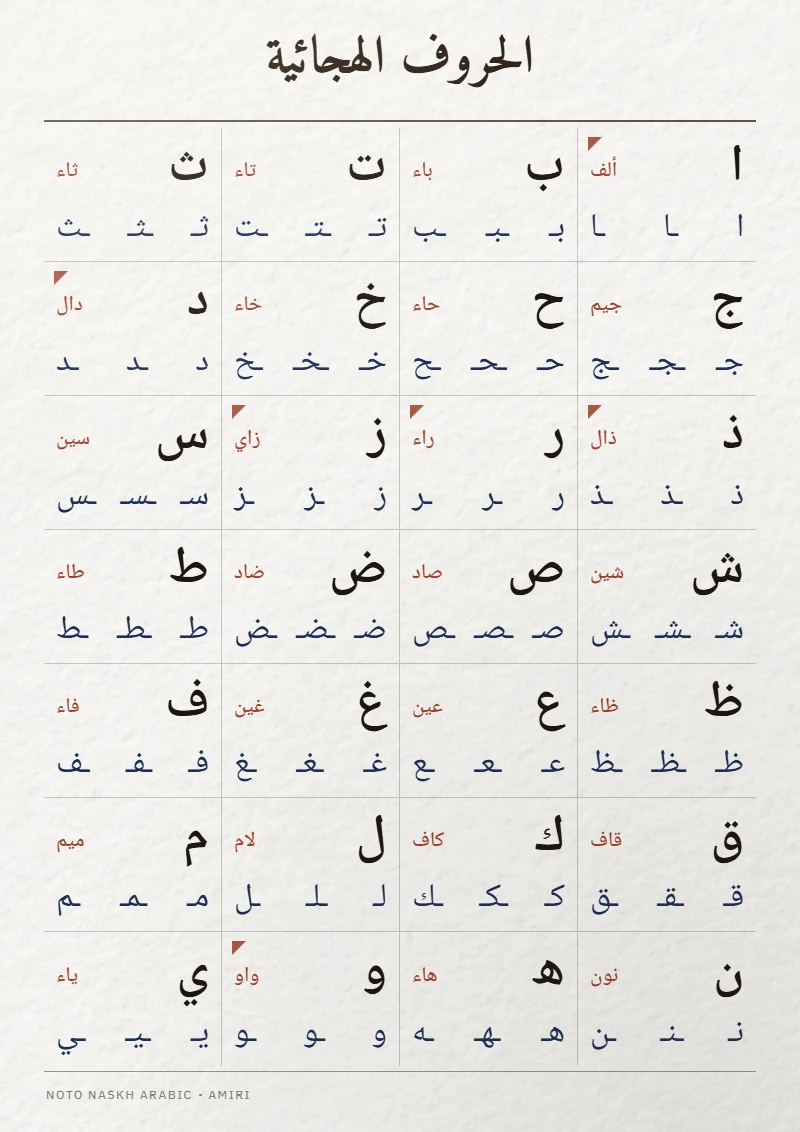
Open the image on its own and print it scaled to the page width. At 800 pixels wide, it prints legibly on A4 for a desk reference or a notebook insert, though not as crisply as a vector file.
Two tips for learners. First, copy the letters in family order, not alphabet order: one skeleton, then its dotted versions. Second, write every new letter in all four positions inside a real word; isolated letters are the shape you will see least.
Typing and displaying the letters
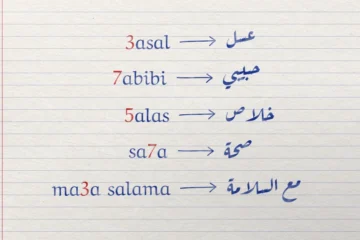
To practice, type the letters on our online Arabic keyboard. It also converts Arabizi as you type: “mar7aba”, “3arabi” and “7abibi” turn into Arabic script. If those numbers puzzle you, read our explainer on Arabizi and the chat alphabet.
For designers and developers, three facts save hours:
- One letter, one code point. Unicode encodes ب once (U+0628 ARABIC LETTER BEH), not four times. The text engine picks the contextual form from the font. The separate “presentation forms” blocks (U+FB50 to U+FDFF and U+FE70 to U+FEFF) exist for compatibility with old systems; text typed with them breaks search and sorting. See the Unicode Arabic chart.
- The tatweel is a character. The stroke used in the chart above is U+0640 ARABIC TATWEEL. It is fine in a teaching chart, wrong as a justification tool in running text.
- Learners need clear shapes and full diacritics. For worksheets, Playpen Sans Arabic brings a handwritten voice, with a weight axis from 100 to 800, and our handwriting-style Arabic fonts offer other informal models; for reading passages with vowel marks, use a book Naskh such as Amiri. Browse the fonts for children’s books and teaching material, or compare Naskh fonts, the style of most printed schoolbooks. To see how Naskh relates to Kufi, Thuluth or Ruq’ah, read Arabic calligraphy styles compared.
FAQ
Does Arabic have capital letters?
No. Arabic has no uppercase and lowercase. The four contextual forms are not capitals: they depend only on a letter’s position in the word. Emphasis is shown with weight, size or color.
Is Arabic hard to read for a beginner?
The script itself is a small system: 28 letters, one joining rule and dots to count. The harder part is reading without short vowels, which comes with vocabulary.
Which way do I write the letters?
Right to left, along a baseline. Write each joined group without lifting the pen where you can, then add the dots and vowel marks.