Arabic Font for Kids: Clear Letters for Reading and Worksheets
8 fonts
Free Arabic fonts for early readers, worksheets and classroom slides, chosen for clear letter shapes and readable vowel marks: Naskh text faces and an open sans, free to print and share.
Style
Use
Access
License
What young readers need
- Plain letter shapes: beginners recognize the forms they practice by hand. A simple Naskh or an open sans is easier to decode than a calligraphic hand.
- Clear dots: several Arabic letters differ only by the number or position of their dots, as in ب ت ث. The dots must stay separate and visible.
- Full vowel marks: early readers rely on harakat (حركات, short-vowel marks). Each mark must sit clearly above or below its own letter.
- Generous size and spacing: large text and extra line height leave room for the marks and for a finger following the line.
Which font for young readers
Choose Scheherazade New, a Naskh from SIL, for reading books, vocalized texts and lesson sheets. Its four weights, Regular to Bold, let you set titles and instructions without changing family.
Noto Naskh Arabic is a text family from Google's Noto collection, delivered as one variable file from 400 to 700. Pick it when the same lesson also exists in Persian or Urdu, since the font covers both.
Almarai is a sans with open, low-contrast shapes in four weights. Choose it for classroom slides, labels, flashcards and worksheets for older pupils. Test its vowel marks at your size: a font that contains a mark does not guarantee room for it in a small caption.
Tracing and dotted-outline fonts are not in the catalog at the moment.
Making worksheets that work
- Print one test page at the real size and have a child or a teacher read it. A screen preview hides crowded marks.
- Leave clear space between the Arabic line and any answer line or box below it, so a kasra (كسرة, the vowel mark below a letter) or a descending letter does not touch it.
- Add harakat with the on-screen layout of the online Arabic keyboard, which includes the vowel, doubling and nunation marks.
- Keep one font per worksheet. Switching styles between exercises makes the same letter look different to a beginner.
- When you spell a word in separate letters, show the joined word next to it. Letters change shape once they connect.
The method in how to choose an Arabic font also works for classroom material. Other reading faces sit among the Naskh fonts. For longer readers, see Arabic fonts for books; for setting up documents, see Arabic fonts for Microsoft Word.
Guides: Kids & school
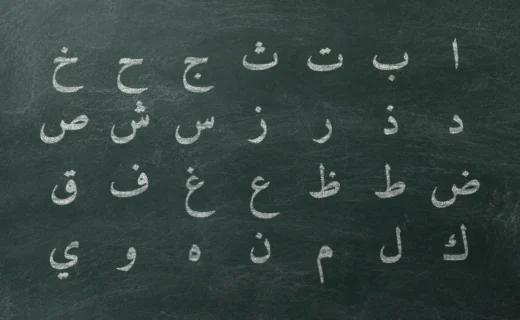
The Arabic Alphabet: 28 Letters, Their Forms and How They Join
All 28 Arabic letters in their four forms, with ALA-LC transliteration and IPA, the six letters that never join forward, dot families, the sounds… Read more : The Arabic Alphabet: 28 Letters, Their Forms and How They Join