Arabic Handwriting Font: Informal Hands for Classrooms and Cafés
8 fonts
Arabic handwriting fonts imitate everyday writing with a marker, a brush or a casual pen, not the ruled proportions of calligraphy. Free ones are rare. This list gathers a teaching hand, a lettering face, a semi-handwritten family, West African hands and a workshop font.
Style
Use
Access
License
Handwriting is not calligraphy
An Arabic handwriting font imitates modern writing by hand: a felt marker on a menu board, a brush on a poster, a quick pen on a note. Calligraphy is a different discipline. It follows rules and proportions, down to letters measured in dots of the pen. A handwriting face aims for the looser rhythm of everyday writing instead.
Why free Arabic handwriting fonts are rare
Arabic letters join, and each one has several contextual forms. A natural-looking hand also needs variants, so the same letter does not repeat identically across a line. The effort is large, and commercial foundries do most of it.
Our research found almost no free modern Arabic cursive in a pen style. The free catalog covers narrower needs, described below.
What to check in a handwritten face
- Letter variation: contextual alternates change repeated letters, as on paper. Test a full sentence, not an alphabet.
- Tool texture: strokes should match the tool you want to suggest, from even, rounded lines to contrasted lettering.
- Joins that still read: check the connections in your real words, including the lam-alif (لا, lam-alif) ligature.
- Coverage: experimental fonts can miss letters, so test the exact wording.
Classrooms, food and children's titles
A handwritten face suits worksheets, children's book captions, café posters, festive labels and friendly invitations. It brings warmth to a few words; dense instructions still need a calmer text face. For school material, see the Arabic fonts for kids; for menus and promotions, the Arabic fonts for flyers and posters.
Handwritten voices in the catalog
Playpen Sans Arabic, from TypeTogether, gives Arabic and Latin text a casual handwritten voice, with alternates that vary repeated letters, in weights from 100 to 800 in one variable file. Use it for activity sheets and captions, and check its shapes against your curriculum.
Marhey, a Namela Type design from Nur Syamsi and Bustanul Arifin, has a hand-lettered look with contrasting strokes, from 300 to 700. Try it for a café poster or a playful book title, and keep prices and dates in a quieter face.
Mikhak, by Amin Abedi, is semi-handwritten, with low contrast and rounded terminals and joints. Besides weight, its variable file has axes for kashida (كشيدة, kashida) elongation and for dot styles. Mikhak is Persian for clove.
Alkalami and Ruwudu, both from SIL, follow Kano writing from West Africa. Use them when the project calls for that regional voice, and name Kano in the brief. They are also filed under the Maghribi script page as approximations.
Am-Hal was drawn collectively in a Hurouf workshop led by Mohamed Gaber, one letter per participant. It suits an experimental poster. The file lacks آ and full Latin, so check your wording first.
Handwriting questions
Can I turn my own handwriting into an Arabic font?
Yes, but plan for far more than an alphabet. You need each letter in all of its forms: isolated, initial, medial and final for most letters, and only isolated and final for the letters that never join to the next one, such as alif, dal, ra and waw. Add the required ligatures such as lam-alif. Then test real words to see whether the joins line up.
Handwriting font or Ruq'ah?
For a note that should look like an adult's quick writing, one of the Ruq'ah fonts can feel closer than a marker-style face. The guide on how to choose an Arabic font covers matching tone to the audience.
For bold headline lettering, browse the Arabic display fonts. Type your phrase with the online Arabic keyboard, check the spelling, and set it in each font's own preview to look at the joins.
Articles about Handwriting
The Arabic Alphabet: 28 Letters, Their Forms and How They Join
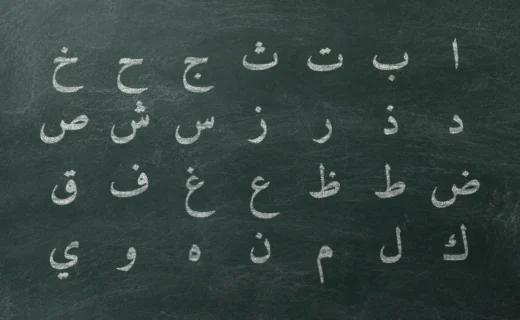
All 28 Arabic letters in their four forms, with ALA-LC transliteration and IPA, the six letters that never join forward, dot families, the sounds… Read more : The Arabic Alphabet: 28 Letters, Their Forms and How They Join
How to Choose an Arabic Font: A Five-Step Method
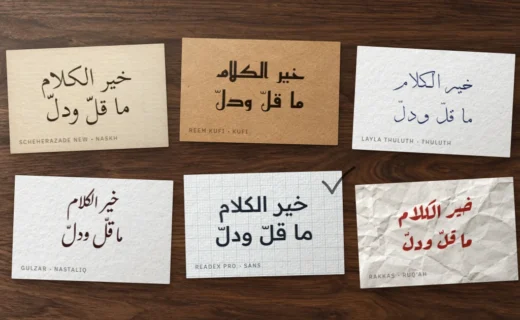
Define the job, pick one of ten Arabic styles, list your constraints, test harakat and joining with your own words, then check the license.… Read more : How to Choose an Arabic Font: A Five-Step Method