Arabizi Explained: Why 3, 7 and 5 Stand for Arabic Letters
Arabizi is Arabic written in Latin letters, with digits standing in for sounds English spelling cannot show: 3 for ع (ʿayn), 7 for ح (ḥa), 2 for the glottal stop ء (hamza). It grew on phones and computers that could not handle Arabic, and it lives on in informal messages, mostly for spoken dialects. Only 3 and 7 mean the same thing everywhere: the other digits change from one country to the next.
Arabizi, Franco, Arabish: names and where it is used
When someone types “7abibi” for حبيبي (my dear), “3arabi” for عربي (Arabic) or “yalla” for يلا (let’s go), that is Arabizi. The usual explanation of the name is a blend of ʿarabi, عربي (Arabic), and inglizi, إنجليزي (English); some writers read it as “Arab Easy”. You will also meet Arabish and Franco-Arabic (in Egypt simply “Franco”, فرانكو). It is used mostly for dialects such as Egyptian, Levantine, Gulf and Maghrebi Arabic. Modern Standard Arabic, the language of books and news, stays in Arabic script.
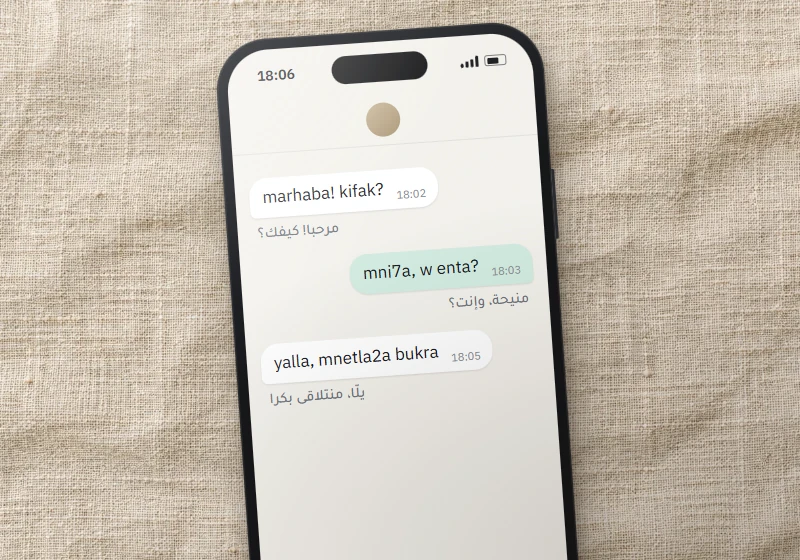
So what does 3 mean in Arabic texting? It stands for ع, the throaty ʿayn of “3arabi” or “ma3a salama” (goodbye). 7 is ḥa. These two values are the same in all five countries of the 2025 survey described below. The other digits move around.
Why digits: they look like the letters
Arabic has consonants with no English equivalent: the throaty ʿayn, the breathy ḥa, the emphatic ṭa, the deep qaf. Early texters needed one keystroke for each, and the number row was right there. Most of the time they picked the digit that looks like the Arabic letter.
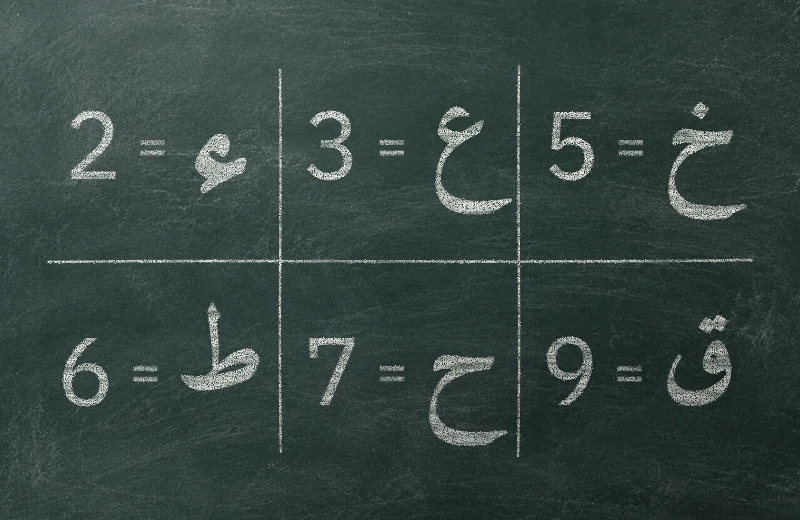
- 3 is a mirrored ع, especially its initial form عـ: the same open bowl.
- 7 echoes the top stroke of ح.
- 2 looks like the small hamza ء.
- 6 recalls the loop and stem of ط.
- 9, with its loop and tail, recalls a mirrored ق. Some writers use it for ص instead.
The 5 is the odd one out: it does not resemble خ (kha). The usual explanation is that خمسة (khamsa, five) starts with that sound. An apostrophe can add the dot that separates two sister letters, as in 3′ for غ (ghayn), but most writers simply type “gh”.
Arabizi numbers chart
| Digit | Letter | Arabizi | Arabic script | Meaning |
|---|---|---|---|---|
| 2 | ء (hamza); ق in Egypt and Lebanon | so2al | سؤال | question |
| 3 | ع (ʿayn) | 3arabi | عربي | Arabic |
| 5 | خ (kha); rare in Algeria, absent in Morocco | 5alas | خلاص | enough, done |
| 6 | ط (ṭa), mainly Gulf | 6ayeb | طيب | OK, good |
| 7 | ح (ḥa) | 7abibi | حبيبي | my dear |
| 8 | غ in Egypt, Lebanon, Tunisia; ه in Algeria and Morocco; ق in parts of the Gulf | 8ali (more often ghali) | غالي (Egypt) | expensive, dear |
| 9 | ق in the Maghreb, ص in the Gulf | 9alb | قلب (Maghreb) | heart |
Example words are ours, chosen to show each value; regional values come from the 2025 survey and, for the Gulf, from the 2003 UAE study and, for the 8, a 2013 article in The National. Only 3 and 7 are safe everywhere: treat every other row as a regional habit, not a rule.
A short history: SMS, email and chat
In the 1990s, many phones and computers sold in the Arab world could not display or type Arabic reliably. Even when they could, Arabic cost more: a text message holds up to 160 characters in the 7-bit GSM alphabet, but only 70 Arabic ones, which need a 16-bit encoding (UCS-2). Writing your dialect in Latin letters was the path of least resistance. Writing in 2009, Microsoft’s Maren team dated the wide use of romanized Arabic online and on phones to the mid-1990s.
Researchers noticed early. In 2002, Mark Warschauer, Ghada El Said and Ayman Zohry found romanized Egyptian Arabic in the informal email and online chat of young Egyptian professionals. In 2003, David Palfreyman and Muhamed Al Khalil studied the instant messages of female university students in the United Arab Emirates. They described this “ASCII-ized Arabic” as creative and social, not just a workaround, and charted Gulf values such as 6 for ط and 9 for ص.
Software followed the users. Yamli, a tool that turns Arabizi into Arabic script as you type, went online on November 15, 2007. Onkosh, Yamli and Google already offered web versions when Microsoft released Maren on July 1, 2009; Maren worked in any Windows program.
Regional differences: what a 2025 survey found
There is no Arabizi standard. The largest survey of its kind so far, according to its authors, was run by Amr Keleg and five co-authors and published in Findings of EMNLP 2026. Their online questionnaire ran from June 9 to August 31, 2025 and collected 189 responses, 144 of them from Algeria, Egypt, Lebanon, Morocco and Tunisia. Participants also spelled, in Arabizi, a list of everyday words from their own dialect, about 40 per dialect. Most were aged 24 to 44; the authors do not claim the sample represents whole countries, and the Gulf is not covered.
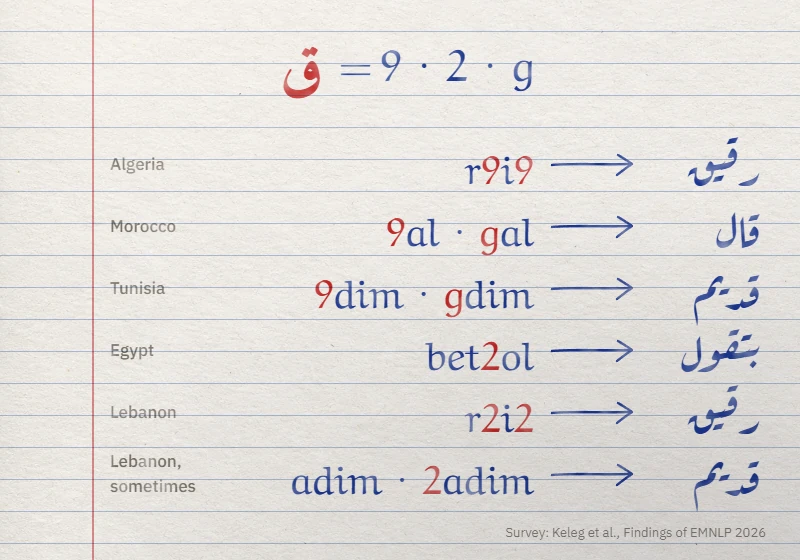
| Letter | Algeria, Morocco, Tunisia | Egypt | Lebanon |
|---|---|---|---|
| ق (qaf) | 9: “r9i9” (thin), “9dim” (old); also g, as in “gal” (he said), and q | 2 in dialect words (“bet2ol”, you say), q in learned words (“qanoon”, law) | 2 or dropped: “r2i2”, “adim” |
| خ (kha) | kh; 5 as common as kh in Tunisia, rare in Algeria, absent in Morocco | mostly 5 | kh, often 5 |
| غ (ghayn) | gh; 8 in Tunisia | gh, 3′ or 8 | gh or 8 |
| ش (shin) | ch | sh | sh, often ch |
Among the five countries surveyed, three details stand out. The 9 for qaf appears only in Algeria, Morocco and Tunisia. The 8 means غ in Egypt, Lebanon and Tunisia, but ه (ha) in Algerian and Moroccan answers. And “ch” for ش, a habit from French spelling, is used everywhere except Egypt: it dominates in the Maghreb, while Lebanese participants mostly write “sh”.
These habits are recognizable. In a second test, ten Arabizi users, two per country, judged whether each version of a sentence could come from their own country. Except for the Algerian and Tunisian pairs, they recognized more than 90% of their compatriots’ versions.
The Gulf follows other habits. The 2003 UAE study charted 9 for ص, so “9alb” reads قلب (heart) to a Moroccan, but would spell صلب (hard, solid) under that Gulf convention. Context does most of the work.
Is Arabizi dying out?
Arabizi is often blamed for weakening written Arabic, and often declared dead now that every smartphone has an Arabic keyboard. The evidence points both ways.
- Decline, unevenly. In the 2025 survey, respondents who now use Arabizi less than when they started texting outnumber those who use it more. The drop is sharpest in Egypt, where 10 of 33 respondents said they had stopped, against one or none in each of the other four countries; Tunisia and Morocco follow. In a 2022 study of TunisiaSat, a Tunisian internet forum, Karen McNeil found that the share of Arabizi comments fell over time.
- Still a habit for many. In every country except Egypt, 4 to 6 respondents said they now use Arabizi much more. A 2024 master’s thesis by Muhammad Wafa at the American University in Cairo found it widely used among Egyptians aged 17 to 23, younger than most of the survey’s participants.
- Practical reasons. Convenience comes up most often in the survey comments. Some write Arabizi for learners, or for Arabs who never learned the script. One Algerian participant put it simply: “My keyboard is in Latin. I never change it.”
The most convincing reading is that Arabizi is a register: the quick, informal voice of friends and family, chosen or dropped depending on who is reading. Several participants point out that some Arabs in the diaspora cannot read the Arabic alphabet: for them, Arabizi is sometimes the only possible way to write, and it can become a way into Arabic letters.
Arabizi in a design: fonts and digits
Arabizi turns up on purpose in social posts, video captions, café menus and T-shirts, often next to the same words in Arabic script. That pairing raises two practical questions.
One font, two scripts. Pick a family that draws Arabic and Latin together, so “mar7aba” and مرحبا share the same weight and rhythm. IBM Plex Sans Arabic offers seven weights with a Latin from the Plex system. Noto Sans Arabic adds a width axis from 62.5 to 100 for long caption lines. Readex Pro is built on the reading-focused approach of Lexend. Vazirmatn ships Arabic and Latin together, with a Latin based on Roboto, and Rubik brings slightly rounded corners for a friendlier tone. More options are on the page for Arabic fonts with English, and for captions on Arabic fonts for video and subtitles.
Digits are letters here. In Arabizi, 3 and 7 must stay Western digits, while the Arabic text next to them may use Arabic-Indic numerals (٣ and ٧). Check how your font draws them. In the upright styles of Zain, version 2.000, the Arabic-Indic digits ٠ to ٩ and the Persian digits ۰ to ۹ have exactly the same shapes as 0 to 9: practical if you want Western numbers everywhere, wrong if your design calls for Eastern Arabic numerals.
On a website, mark Arabizi with lang="ar-Latn", the standard tag for Arabic written in Latin letters, so browsers and assistive technology can tell it apart from English. Test the result with a screen reader: support varies.
From Arabizi back to Arabic script
For learners, Arabizi is a useful bridge. Our online Arabic keyboard has a Smart mode that reads it as you type. Each word turns into Arabic in place, with suggestions ranked by how common each word is. Press Space to keep the highlighted one, or the arrow keys to pick another. A tip explains the 2 and the 9 as you type them, and the “?” guide shows the full chart.
- “9alb” and the Egyptian “2alb” both give قلب (heart); with “9alb”, صلب also appears among the suggestions.
- “9aba7” gives صباح (morning): the keyboard picks the more common word.
- “ma3lich” gives معلش (never mind) first and offers معليش.
- “8” is read first as ق, a Gulf habit, then as غ: “8ali” gives قالي, with غالي as the second suggestion. For غ, “gh” (or 3′) is the safe choice.
- Dialect words work too: “dilwa2ti” becomes دلوقتي (now, Egyptian), “ch7al” becomes شحال (how much, Maghrebi).
The keyboard remembers the words you choose, in your own browser. Always read the result before you copy it: a dialect can be spelled several ways. To check the output letter by letter, our guide to the 28 letters of the Arabic alphabet shows each one and how it joins. Once the text is in Arabic script, our guide on how to choose an Arabic font helps you set it well, and if it ends up in a document, see Arabic in Microsoft Word for the settings that matter.