Maghribi Script: History, Letterforms and Free Font Approximations
2 fonts
Maghribi script, the hand of the Maghreb and al-Andalus, has no complete free font we can host yet. The fonts in this list follow the Kano writing of West Africa: useful approximations, not Maghribi proper. This page explains the difference.
Style
Use
Access
License
Maghribi script, from Kairouan to Fez and West Africa
Maghribi (الخط المغربي, al-khatt al-maghribi) developed in the Muslim West: the Maghreb and al-Andalus. Kairouan was an early center. The script flourished in al-Andalus and in Fez, and its descendants spread into West Africa. In the 19th century, lithographic presses in Fez printed books in Maghribi.
It has several varieties. Mabsut (المبسوط, al-mabsut) served for Quran copies, mujawhar (المجوهر, al-mujawhar) for documents and correspondence, and musnad (المسند, al-musnad) for notarial deeds. Maghribi forms of Thuluth and Kufi also exist.
Letters that set Maghribi apart
- Fa' with its dot below: ڢ, where eastern styles place one dot above.
- Qaf with a single dot above: ڧ, instead of two.
- Its own abjad order: the traditional sequence of letters in the Maghreb differs from the eastern one.
- Wide final curves: final letters end in broad, open curves.
One consequence for proofreading: a Maghribi qaf looks like an eastern fa'. Readers trained on Naskh can misread a word, so check these letters first when you proof a Maghribi text.
Where Maghribi lives today
Maghribi is used for Qurans in the Warsh reading across the Maghreb and West Africa. It also shapes visual identities and signage, where a Moroccan or Andalusian reference matters. For heritage artwork, the Arabic calligraphy fonts gather free faces that follow a named hand, Kano writing among them.
Kano fonts, the free approximations in this list
The gap in free fonts covers Moroccan, Andalusian and mabsut styles alike. Few digital fonts implement the conventions above, and the ones we found are not, as far as we could check, licensed for self-hosting.
The grid shows designs based on West African writing instead. Alkalami, from SIL, takes the writing of the Kano region, in Nigeria, and of Niger as its model. It is named after the local word for the tool used to write on wooden boards. Thick strokes along the baseline, set against thin uprights, give it a dark texture, and its deep descenders call for wide line spacing. It comes in one weight.
Ruwudu, also from SIL, serves West African languages written in the Rubutun Kano style, in four weights. Its project warns that letters needed by other languages may be missing, so have a fluent reader proof your text.
Harmattan, filed under modern sans, simplifies Arabic script for West African languages in a Warsh-style rendering, with basic connecting forms. Compare it for Ajami teaching material, in local languages written with Arabic script.
Before you use any of them for a Moroccan text, check how they draw fa' and qaf. None of them stands in for the Maghribi of Fez or al-Andalus.
Maghribi questions
Why are Kano fonts filed under Maghribi?
West African Arabic-script hands, Kano writing among them, are usually traced back to the Maghribi tradition. The grouping helps you find these fonts; it does not make them Moroccan. Alkalami and Ruwudu also appear among the Arabic handwriting fonts.
Can these fonts set a Warsh Quran?
Do not treat them as a shortcut. Harmattan's Warsh-style forms are a simplification for West African languages, not a guarantee for a Quran edition. Work from a verified edition and have it proofread.
What can a Moroccan brand use meanwhile?
Commission lettering from a calligrapher who knows Maghribi, or set the name in a free font with a clear historical reference of its own, such as one of the Kufi fonts, and name that reference in the brief rather than calling it Maghribi. The guide on how to choose an Arabic font helps match that reference to the brand's tone.
To prepare a short test word, use the online Arabic keyboard, then have a native reader confirm the spelling before you paste it into a font's preview.
Articles about Maghribi
Arabic Calligraphy Styles Compared: A Visual Key to Nine Scripts
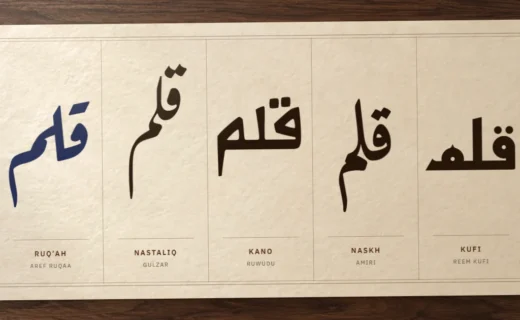
Kufi, Naskh, Thuluth, Diwani, Ruq'ah, Nastaliq, Maghribi and the rarer pens: how to tell them apart by angle, alif and baseline, where each one… Read more : Arabic Calligraphy Styles Compared: A Visual Key to Nine Scripts
How to Choose an Arabic Font: A Five-Step Method
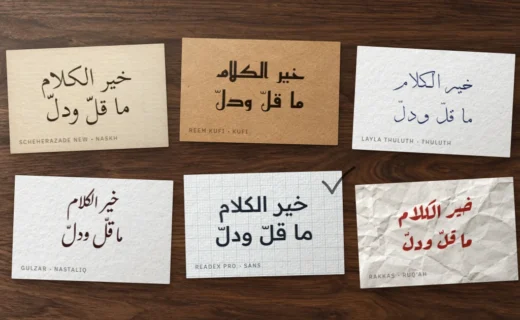
Define the job, pick one of ten Arabic styles, list your constraints, test harakat and joining with your own words, then check the license.… Read more : How to Choose an Arabic Font: A Five-Step Method