Free Arabic Calligraphy Fonts for Titles and Artwork
14 fonts
Typefaces that follow a specific hand: Ruq’ah, Urdu Nastaliq and the Kano writing of West Africa. Each one is free under the SIL Open Font License, including for commercial artwork.
Style
Use
Access
License
What makes a font work for calligraphic design
- A named tradition: a good calligraphic font follows one hand closely. Know which one you use, so the brief, the caption and the client describe the same style.
- Word shapes, not letters: calligraphy lives in how letters join, overlap and descend. Judge a font on your full phrase, never on an alphabet chart.
- Vertical space: Nastaliq words slope downward and Kano writing has deep descending shapes. Both need taller lines than a Naskh text face.
- Vowel marks: Ruq'ah is usually written without full harakat (حركات, short-vowel marks). If your phrase needs them, test them at the final size.
- Rights for the artwork: the SIL Open Font License allows use in commercial pieces, prints and products. For artwork, its key limit is that you may not sell the font file on its own.
Which hand fits your piece
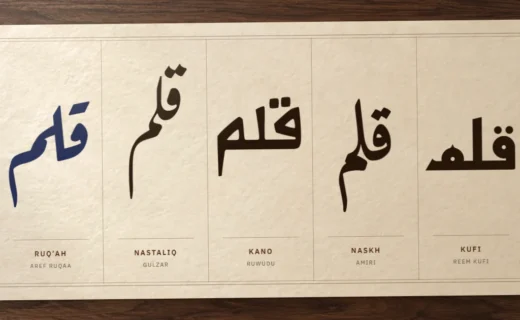
Aref Ruqaa follows the compact, everyday Ruq'ah (رقعة, ruq'a) hand. Pick it, in Regular or Bold, for short titles, quotes and greetings that should feel written by a confident pen.
For Urdu poetry and verse, compare the Nastaliq (نستعليق, nasta'liq) designs. Gulzar, from a team led by Borna Izadpanah, has a single weight. Noto Nastaliq Urdu, from Google's Noto collection, is a variable file from 400 to 700, so a title can be heavier than the verse. For an Arabic-language piece, Arabic readers may expect a different hand.
Alkalami is based on writing from the Kano region of Nigeria and from Niger, with heavy baseline strokes and narrow verticals. Use it when the piece calls for that West African voice, and name Kano as the reference in your brief.
The catalog has no Thuluth or Diwani face yet. For Kufi, compare the simplified Noto Kufi Arabic with Qahiri’s manuscript-based calligraphic design.
From typed text to finished artwork
- Take the phrase from a reliable written source or from an Arabic reader, not from a transliteration. Use the online Arabic keyboard only to type a name or check a word.
- Paste the final text into each font page's preview before any layout work. A font draws exactly what you give it, mistakes included.
- Scale the text proportionally. Horizontal or vertical stretching distorts the stroke contrast that makes the style recognizable.
Aref Ruqaa belongs to the Ruq'ah style, and the Urdu faces to the Nastaliq style. Before you commit to a hand, the guide on how to choose an Arabic font compares Ruq'ah with Naskh and modern sans. A calligraphic name often ends up on a card or a brand: see Arabic wedding invitation fonts and Arabic fonts for logos.
Awami Nastaliq requires Graphite 1.3.4 or later. Check it in LibreOffice or Firefox with Graphite enabled; Chrome and Safari may show an incorrect preview.
Guides: Calligraphic design
Arabic Calligraphy Styles Compared: A Visual Key to Nine Scripts
Kufi, Naskh, Thuluth, Diwani, Ruq'ah, Nastaliq, Maghribi and the rarer pens: how to tell them apart by angle, alif and baseline, where each one… Read more : Arabic Calligraphy Styles Compared: A Visual Key to Nine Scripts