Nastaliq Font for Urdu Text: Line Height, Shaping and Free Files
4 fonts
Each free nastaliq font here was designed for Urdu, the language that made this sloping Persian hand its standard script. All of them need generous line height, one depends on Graphite shaping, and Persian readers may find some forms less familiar.
Style
Use
Access
License
A Persian hand that became the script of Urdu
Nastaliq (نستعليق, nasta'liq) was born in Iran in the 14th and 15th centuries, from the meeting of Naskh and ta'liq (تعليق, ta'liq). Tradition attributes it to Mir Ali Tabrizi. Later masters include Mir Ali Heravi in the 16th century and Mir Emad Hasani, who died in 1615.
It became the script of Persian poetry and the standard script of Urdu, in newspapers and books, as well as of other South Asian languages. Arabic speakers often call it "the Persian script" (الخط الفارسي, al-khatt al-farisi).
The cascade: how Nastaliq sits on a line
- Diagonal words: each word descends from right to left, so it ends lower than it starts.
- Cascade: the next word starts high again, so a line reads as a series of descending steps.
- Long horizontals: some strokes stretch far along the line.
- Strong contrast: thick and thin parts of a stroke differ sharply.
- Tall lines: it needs more space between lines than Naskh and is harder to set at small sizes.
Urdu reading, poetry and the web
Use Nastaliq for Urdu articles, books, poetry and titles. On screen, plan the layout around it. A text box sized for Latin can clip descending forms, so test a multi-line passage, change the size and check the box's upper and lower edges. For Urdu books and print, compare the Arabic fonts for books; for verse and artwork, the Arabic calligraphy fonts.
Shaping is the other constraint, covered under Awami Nastaliq below.
Comparing the Urdu Nastaliq fonts
Pick Noto Nastaliq Urdu when an Urdu article or interface needs a heading heavier than its text. A single variable file from Google's Noto project moves from 400 to 700.
Gulzar comes with an original Latin companion, useful for bilingual Urdu–English captions. Borna Izadpanah leads the project, with Fiona Ross advising on Urdu, Alice Savoie on the Latin and Simon Cozens on engineering; the design is grounded in studies of Urdu lettering and calligraphy. One weight is supplied, so vary size instead.
Awami Nastaliq, from SIL, goes beyond Urdu to languages with extra base letters and vowel marks, in five weights from 400 to 800. Its shaping relies on Graphite, version 1.3.4 or newer. LibreOffice and Firefox, with Graphite switched on, can render it, while Chrome and Safari may not. Check your PDF export too.
All of these were drawn with Urdu readers in mind, and Persian Nastaliq is even less covered by free fonts.
Nastaliq questions
How is Nastaliq different from Naskh?
Naskh keeps words on a level baseline and suits compact Arabic text. Nastaliq slopes each word downward and needs much taller lines. Arabic readers usually expect Naskh for running text; for Urdu, Nastaliq is the standard. For the Arabic side of a bilingual Urdu–Arabic project, use one of the Naskh fonts. The guide on how to choose an Arabic font explains how to test candidates against your audience.
Will an Urdu Nastaliq work for Persian text?
First check that the font contains every character in your Persian text. Even then, the forms may not match what Persian readers expect, so ask one to judge a full paragraph before you publish.
Is the slope an italic?
No. The diagonal movement is part of the script. None of these fonts has a slant axis or an italic, and a software slant will distort the letters.
The online Arabic keyboard helps with an Arabic test line; for Urdu text, use a full Urdu input method.
Articles about Nastaliq
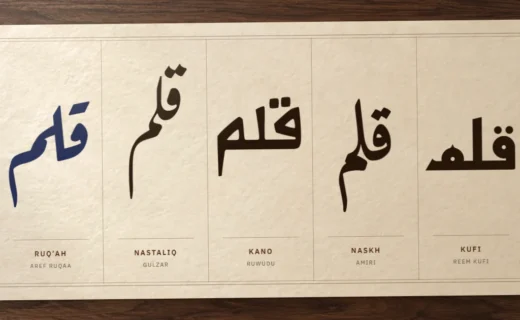
Arabic Calligraphy Styles Compared: A Visual Key to Nine Scripts
Kufi, Naskh, Thuluth, Diwani, Ruq'ah, Nastaliq, Maghribi and the rarer pens: how to tell them apart by angle, alif and baseline, where each one… Read more : Arabic Calligraphy Styles Compared: A Visual Key to Nine Scripts
How to Install Arabic Fonts on Windows, macOS and Linux
Extract the zip, install static or variable font files for yourself or every user, test joining, shadda and digits, then fix a font that… Read more : How to Install Arabic Fonts on Windows, macOS and Linux
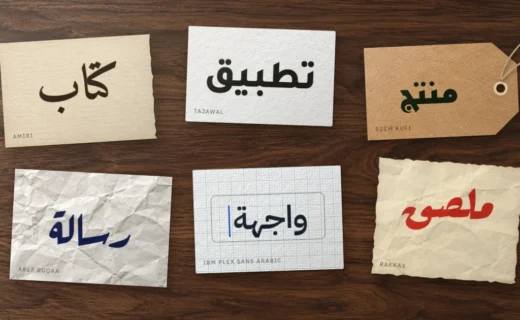
The Best Free Arabic Fonts in 2026: 12 Picks From 109 Tested
Twelve free Arabic fonts picked from 109 tested families: Amiri, Scheherazade New, IBM Plex Sans Arabic, Tajawal, Reem Kufi, Lalezar, Aref Ruqaa and more,… Read more : The Best Free Arabic Fonts in 2026: 12 Picks From 109 Tested
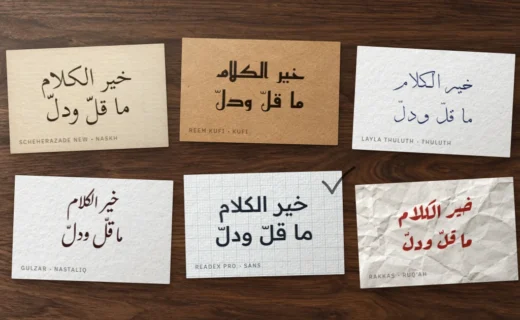
How to Choose an Arabic Font: A Five-Step Method
Define the job, pick one of ten Arabic styles, list your constraints, test harakat and joining with your own words, then check the license.… Read more : How to Choose an Arabic Font: A Five-Step Method