Ruqaa Font for Handwritten-Looking Arabic Titles and Logos
3 fonts
A ruqaa font imitates the quick hand of everyday Arabic writing. The free fonts here are a classical calligraphic Ruq’ah in two weights and a single-weight display face from Egyptian film posters.
Style
Use
Access
License
Ruq'ah, the everyday hand of the Arab world
Ruq'ah (رقعة, ruq'a) is an Ottoman script of the 19th century. Tradition credits Mumtaz Bey with its codification. It became the everyday handwriting in much of the Arab world and is taught at school, so a Ruq'ah title tends to read as personal and familiar rather than ceremonial.
Do not confuse it with riqa' (الرقاع, al-riqa'), one of the six classical pens. Riqa' is older and a different style, despite the similar name.
How Ruq'ah looks on the line
- Speed: letters keep only the strokes a fast pen needs.
- Short letters on the line: forms stay compact and sit on the baseline.
- Low contrast: strokes keep a fairly even thickness.
- Toothless sin and shin: س and ش are written as one smooth stroke, without the teeth they have in Naskh.
- Joined dots: two dots are often written as one short dash, and three as a small caret-like mark.
Notes, signs and retro posters
A ruqaa font suits a handwritten note, a shop sign, a title, a restaurant or craft logo, or a poster with a retro feel. Its speed shows on a handful of words. For brand marks, compare the Arabic fonts for logos; for event and campaign artwork, the Arabic fonts for flyers and posters.
Aref Ruqaa or Rakkas
Aref Ruqaa stays close to classical calligraphic Ruq'ah. Abdullah Aref drew the Arabic with Khaled Hosny, and Alif Type publishes it in Regular and Bold. Use it for a name, a quote or a greeting that should look written by hand, with a steady pen.
Rakkas, by Zeynep Akay, takes its cue from the Ruq'ah on 1950s and 1960s Egyptian movie posters. Contextual alternates change the shapes from word to word, so test several real words, not one. It has one weight; leave room above and below the line for its cascading forms.
Both are display faces. For a paragraph, switch to one of the Naskh fonts and keep Ruq'ah for the headline. Rakkas also appears in the Arabic display fonts list, next to other poster faces.
Ruq'ah questions
Which Ruq'ah font for a bilingual title?
It depends on the Latin voice you want. Aref Ruqaa's Latin comes from Hermann Zapf's Euler design, so English words get a hand-drawn, calligraphic feel. Rakkas pairs its Arabic with an informal take on blackletter that shares the poster mood. Start from the built-in Latin, and add a third family only if the layout needs one.
Does Ruq'ah use vowel marks?
Not usually: Ruq'ah is mostly written without full harakat (حركات, short-vowel marks). When a verse or a children's title needs them, test the marks at the final size in the font preview before you commit.
Is there a Ruq'ah model for handwriting practice?
Playpen Sans Arabic, a handwriting family, has optional Ruq'ah forms among its alternates. They are not necessarily the shapes taught first, so leave them off for beginners unless your program uses them.
Type your name or brand with the online Arabic keyboard, have the spelling checked, then try it in the editable previews of Aref Ruqaa and Rakkas. To decide whether a handwritten voice fits the audience at all, read the guide on how to choose an Arabic font.
Articles about Ruq'ah
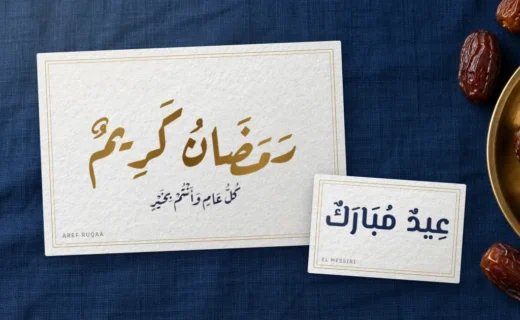
Ramadan Kareem in Arabic and Eid Mubarak: Spelling, Meaning, Lettering
Every Ramadan and Eid greeting with its exact Arabic spelling, vowel marks, meaning and reply, the Kareem or Mubarak debate, and free fonts tested… Read more : Ramadan Kareem in Arabic and Eid Mubarak: Spelling, Meaning, Lettering
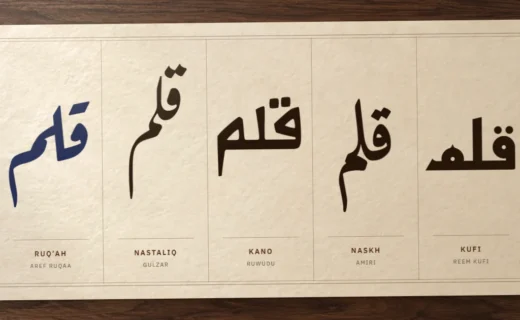
Arabic Calligraphy Styles Compared: A Visual Key to Nine Scripts
Kufi, Naskh, Thuluth, Diwani, Ruq'ah, Nastaliq, Maghribi and the rarer pens: how to tell them apart by angle, alif and baseline, where each one… Read more : Arabic Calligraphy Styles Compared: A Visual Key to Nine Scripts
Arabic Text in Photoshop, Illustrator and InDesign: Setup Guide
Photoshop now shapes Arabic on its own; Illustrator and InDesign still need the right composer. Exact menu paths for direction, digits, diacritics and kashida,… Read more : Arabic Text in Photoshop, Illustrator and InDesign: Setup Guide
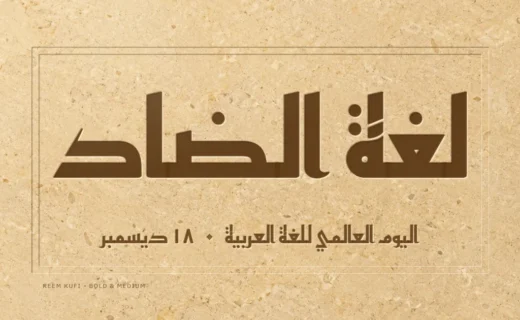
World Arabic Language Day: Why 18 December, Themes and Type Ideas
Why the UN chose 18 December, how UNESCO came to mark it, every recent theme checked at the source, and ways to celebrate through… Read more : World Arabic Language Day: Why 18 December, Themes and Type Ideas
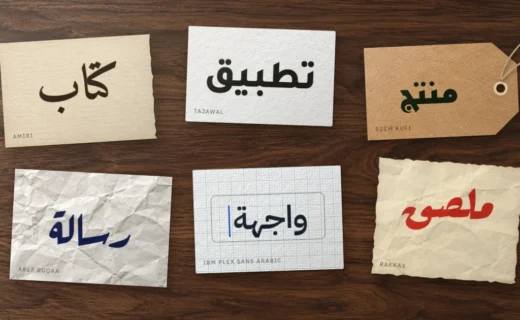
The Best Free Arabic Fonts in 2026: 12 Picks From 109 Tested
Twelve free Arabic fonts picked from 109 tested families: Amiri, Scheherazade New, IBM Plex Sans Arabic, Tajawal, Reem Kufi, Lalezar, Aref Ruqaa and more,… Read more : The Best Free Arabic Fonts in 2026: 12 Picks From 109 Tested
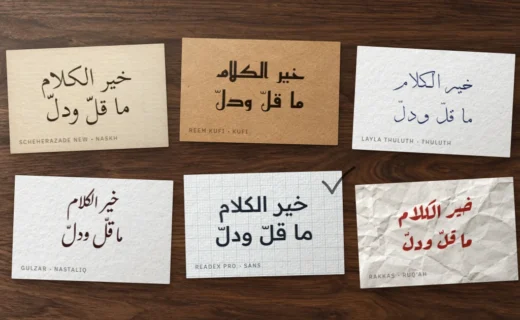
How to Choose an Arabic Font: A Five-Step Method
Define the job, pick one of ten Arabic styles, list your constraints, test harakat and joining with your own words, then check the license.… Read more : How to Choose an Arabic Font: A Five-Step Method